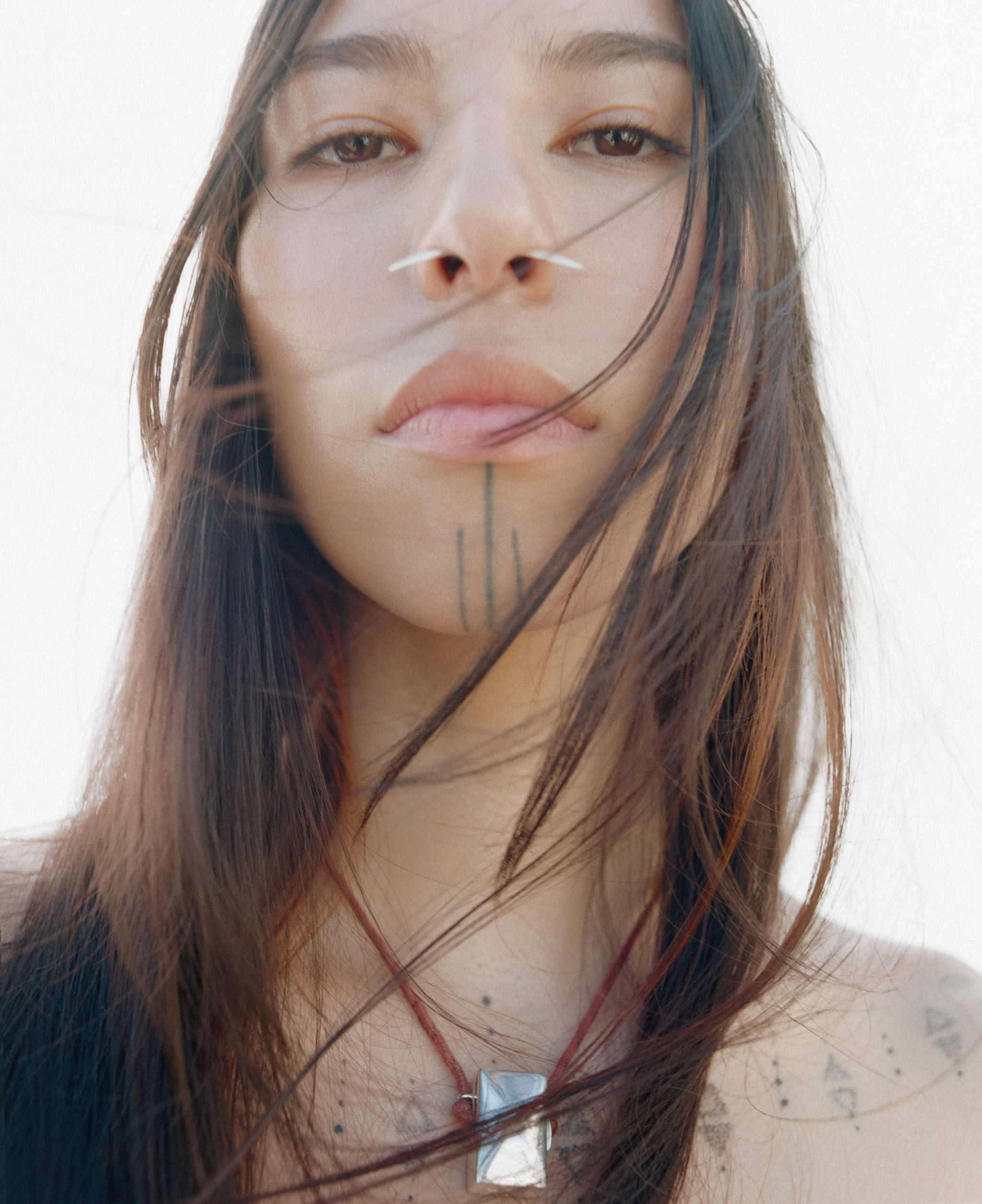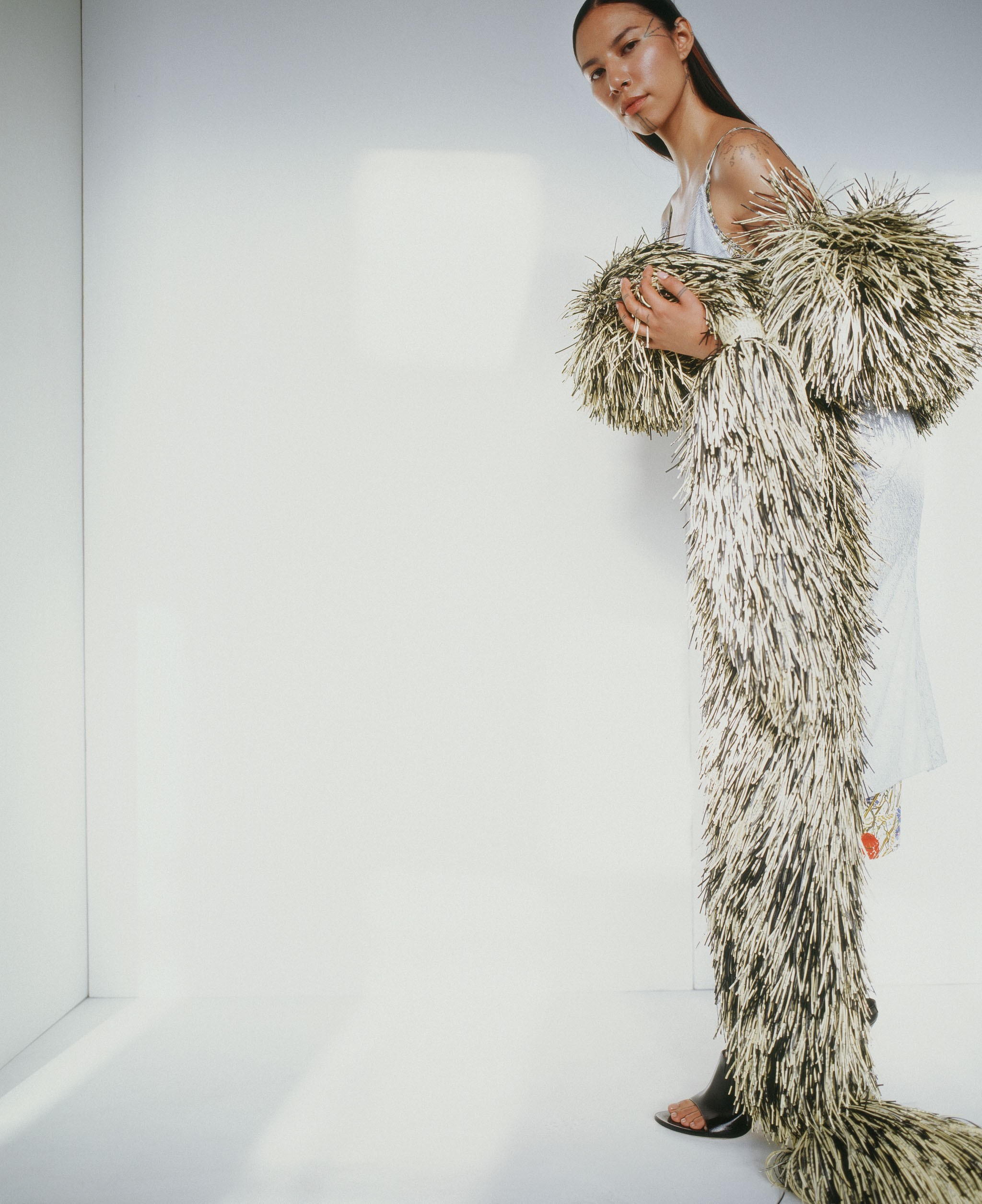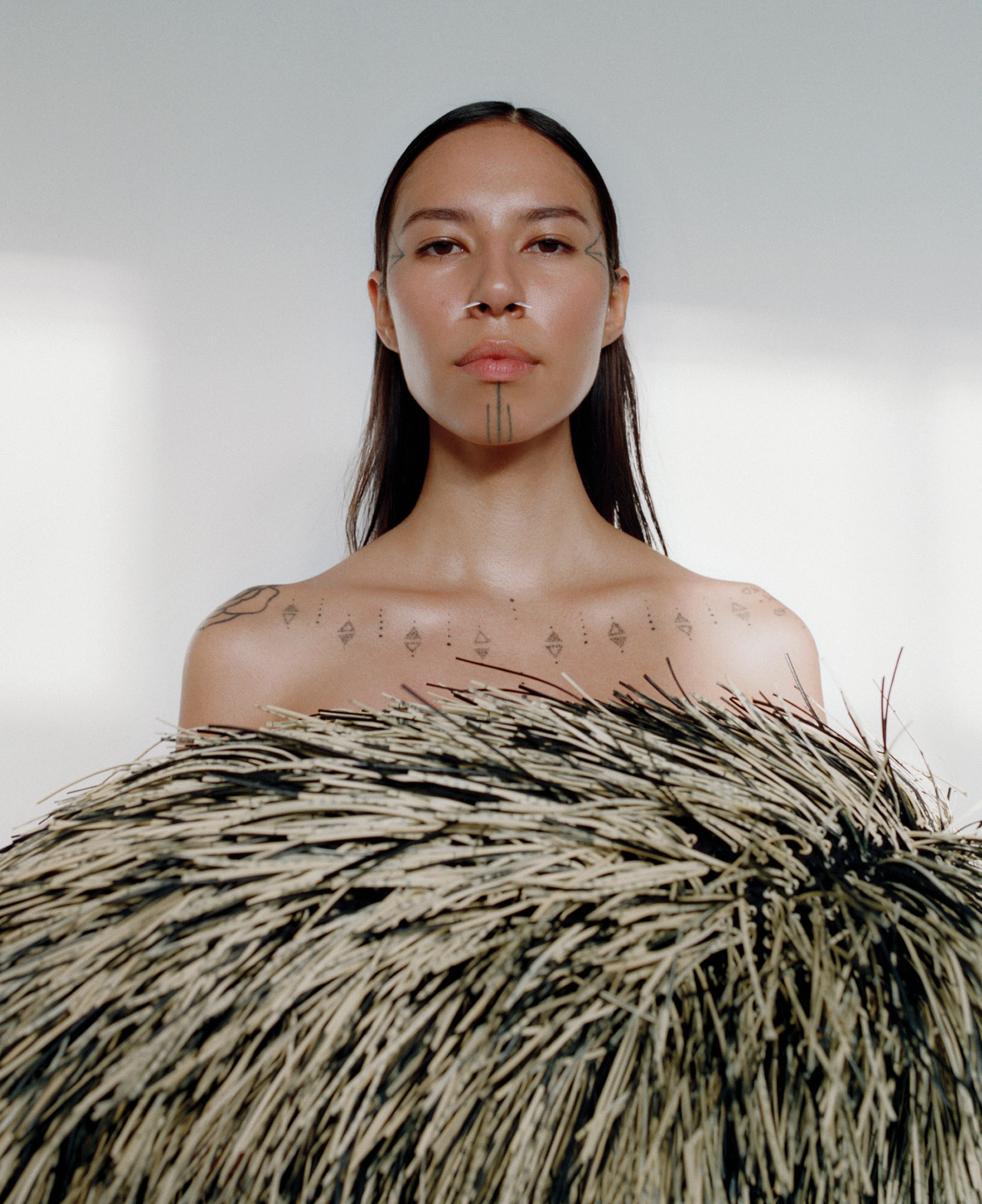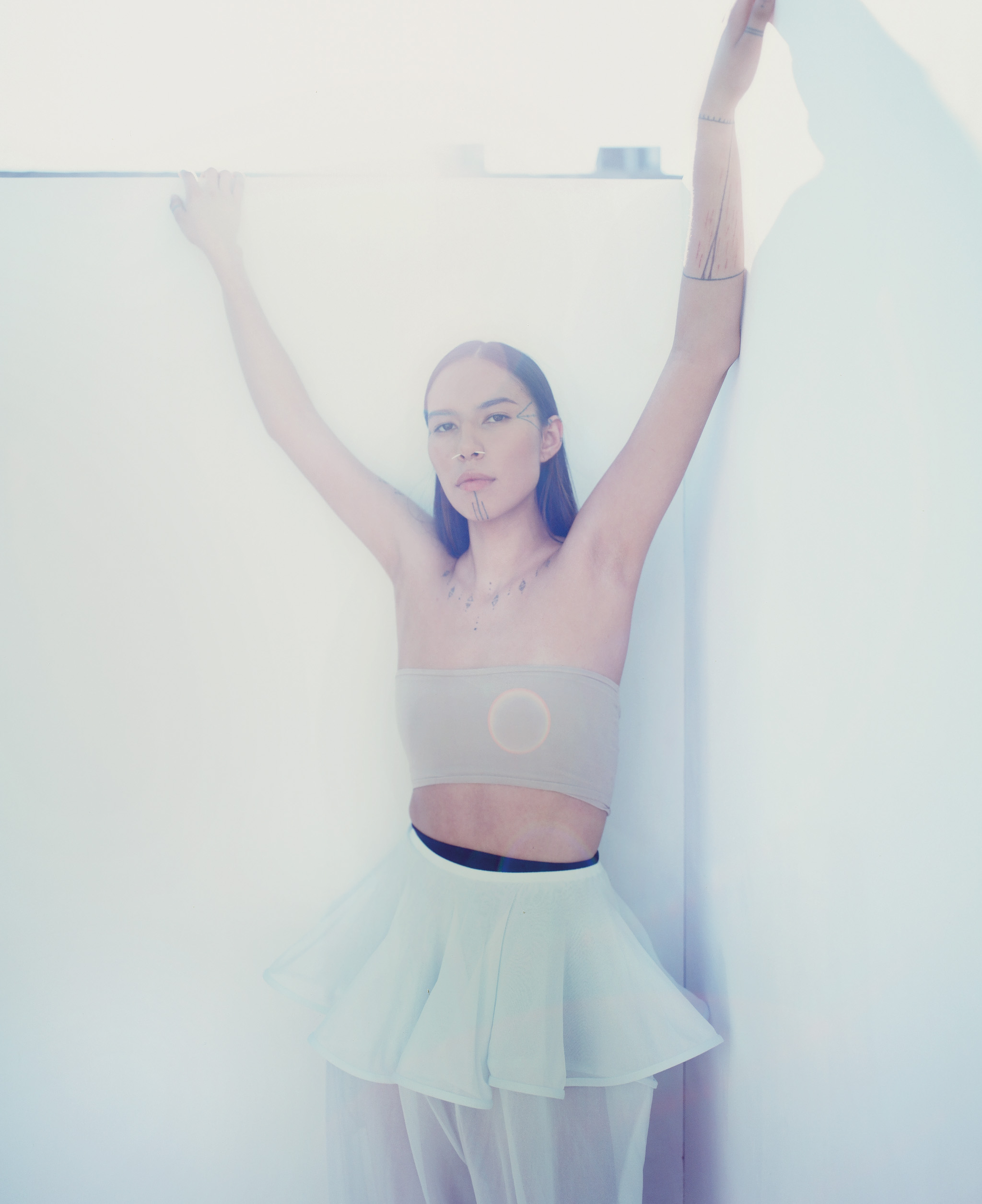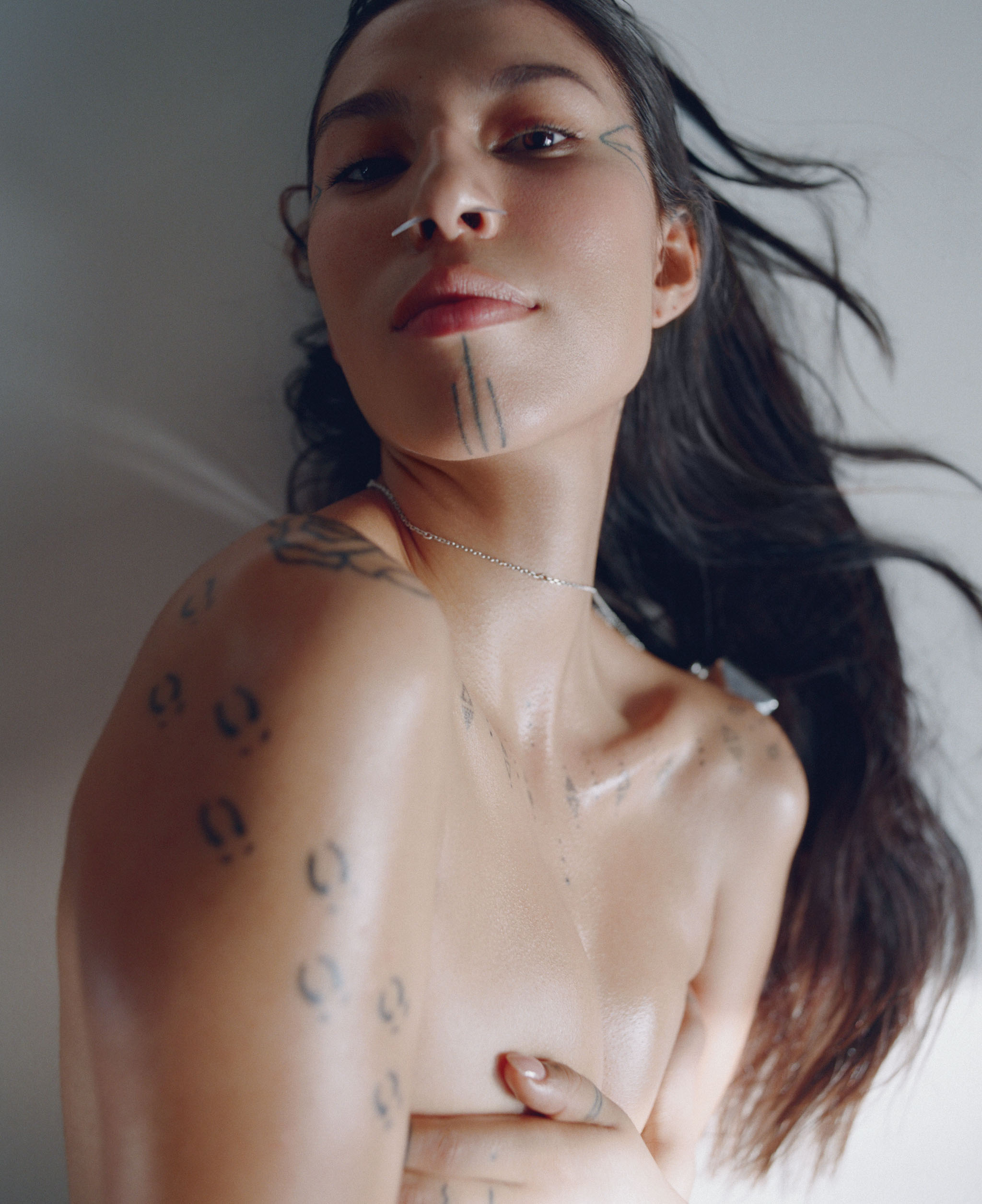
Expressing a shared anger at the current administration’s support of the multiple unfolding genocides as well as its unravelling of the progress made on issues such as climate justice, racial equality and Indigenous rights, American model and activist Cameron Russell interviews Indigenous model, activist and fourth-generation land protector Quannah ChasingHorse. A Two-Spirit from the raven clan of the Hän Gwich’in tribe on her mother’s side and the Sicangu Lakota tribe on her father’s side, ChasingHorse walks in two worlds: femininity and masculinity, peacemaker and warrior, her sacred Alaskan homelands and the rest of the world.
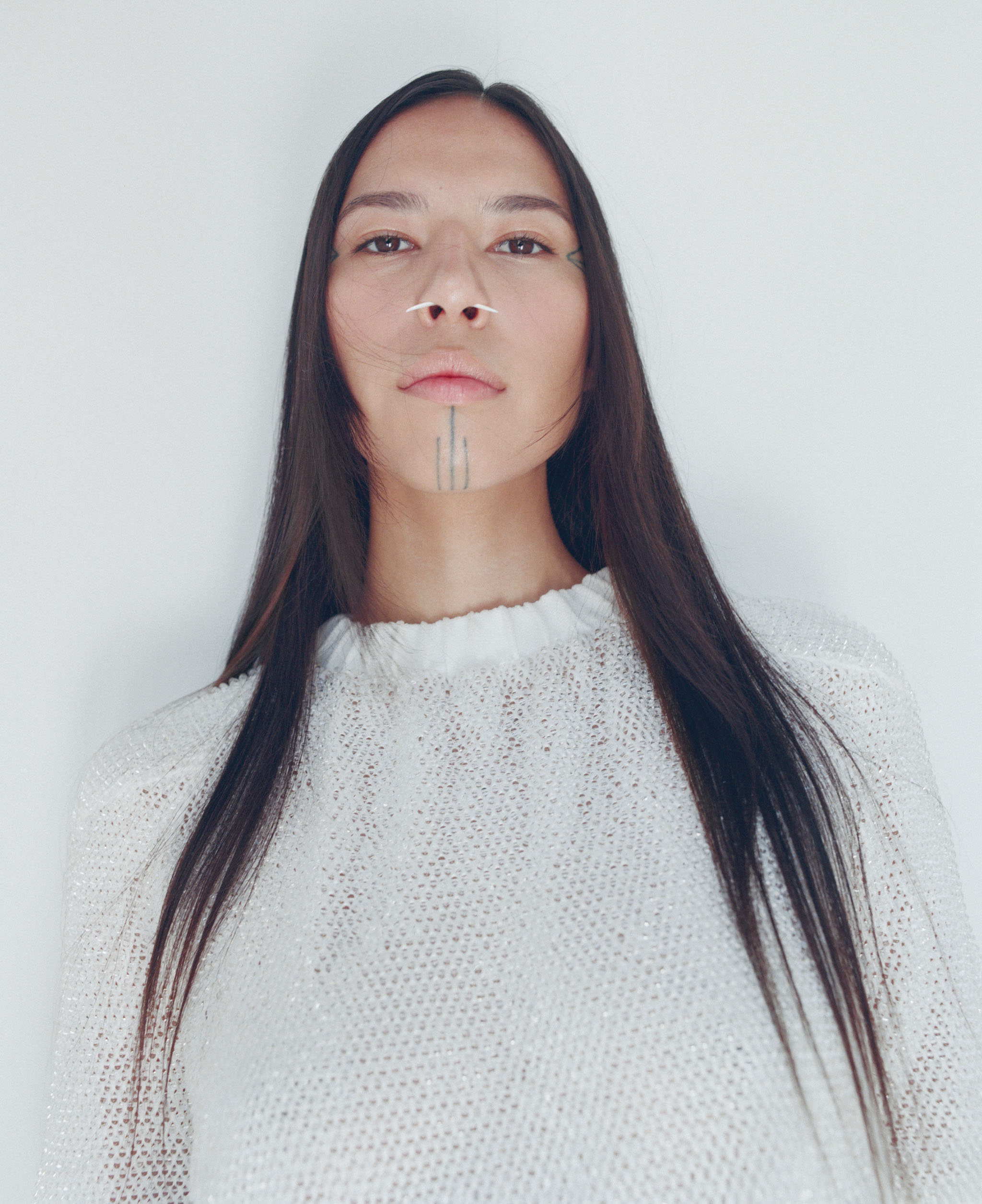
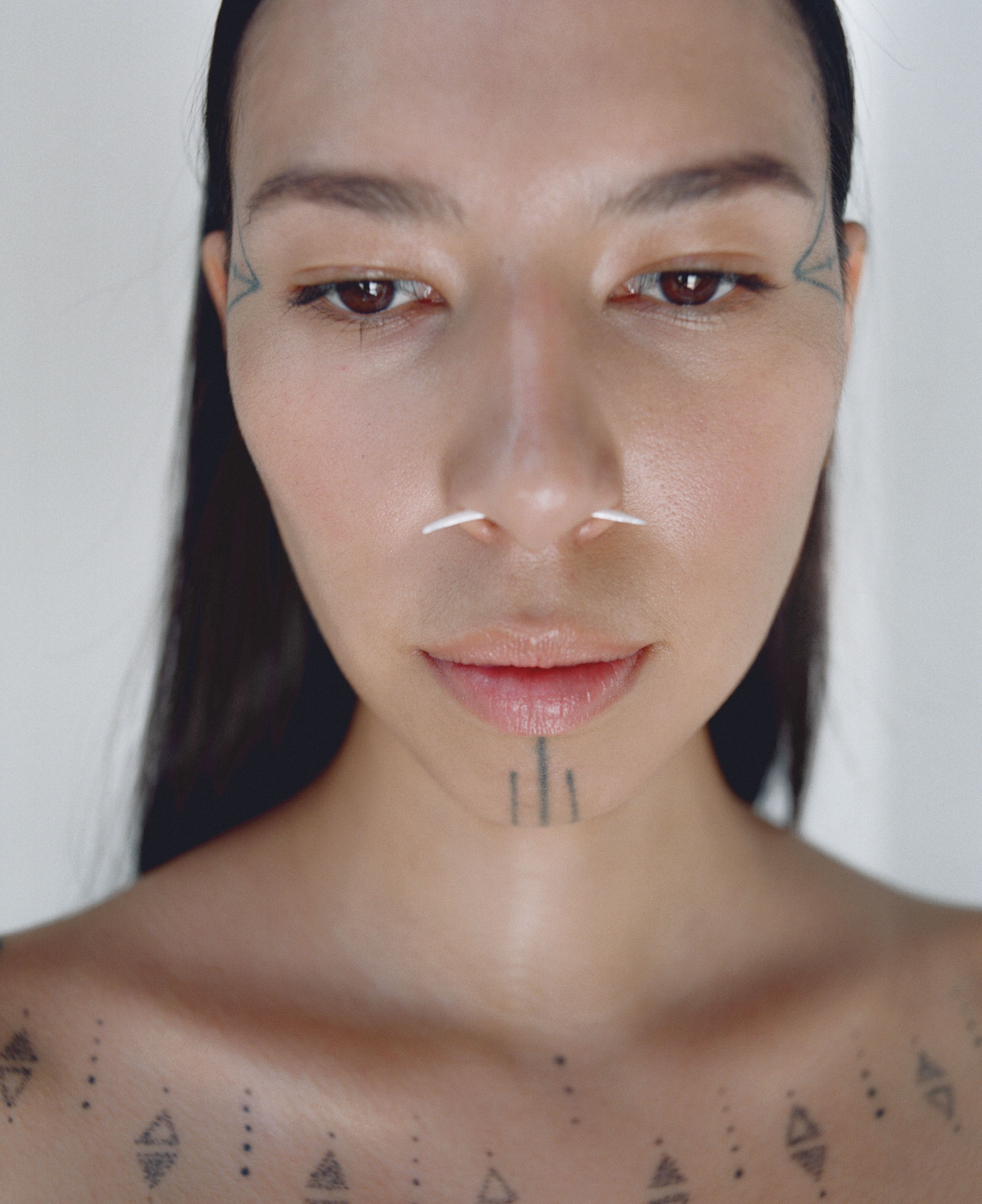
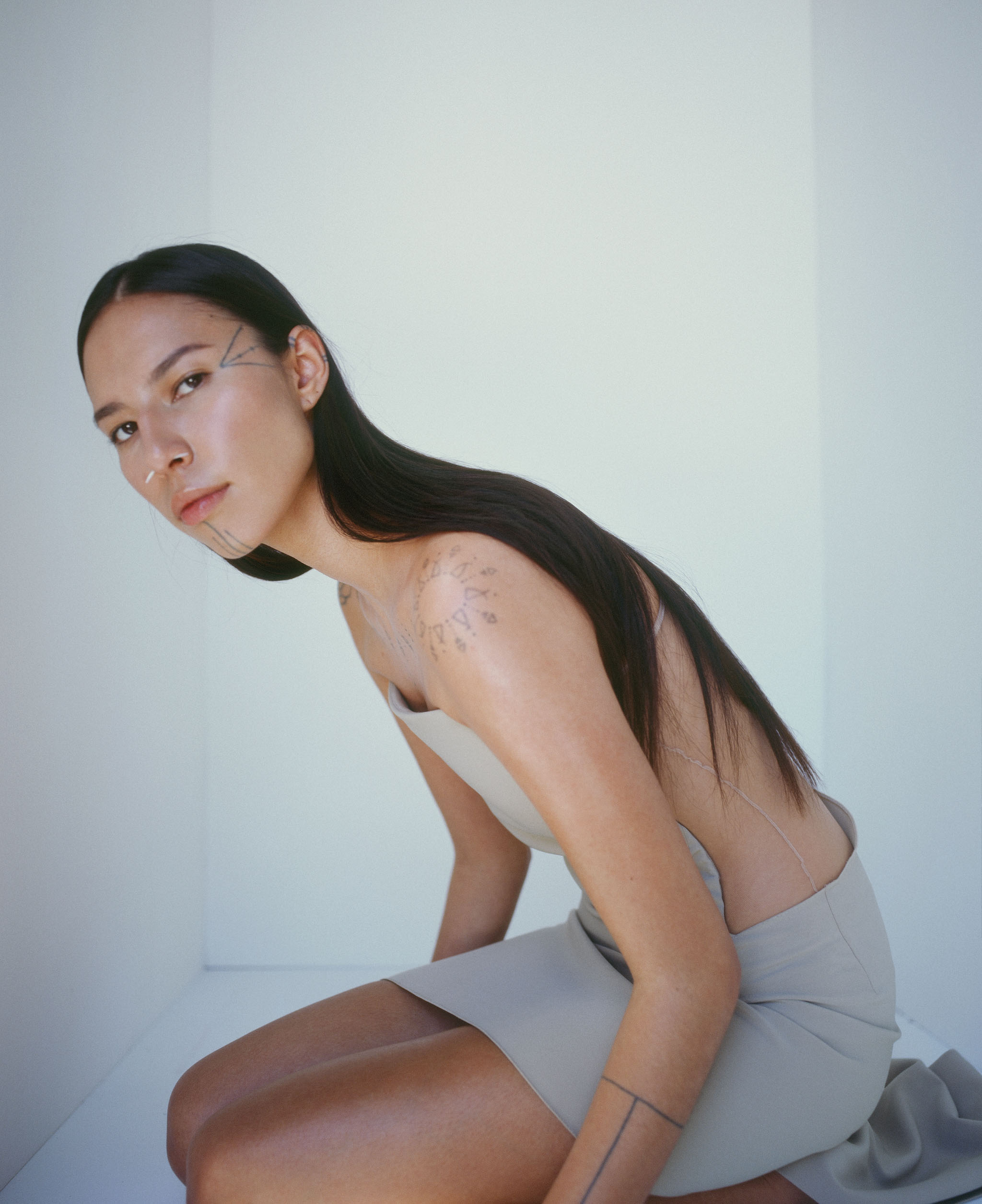
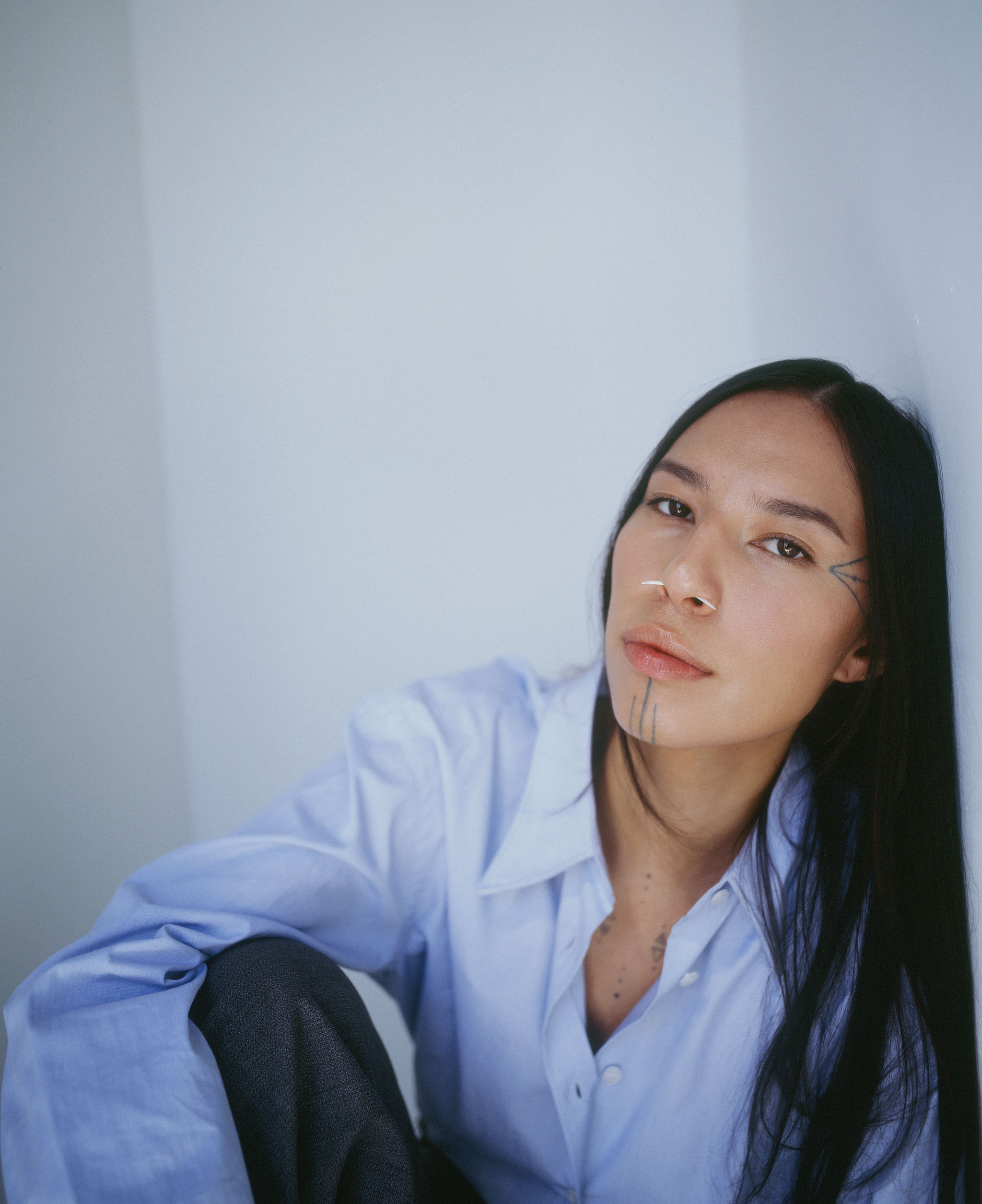
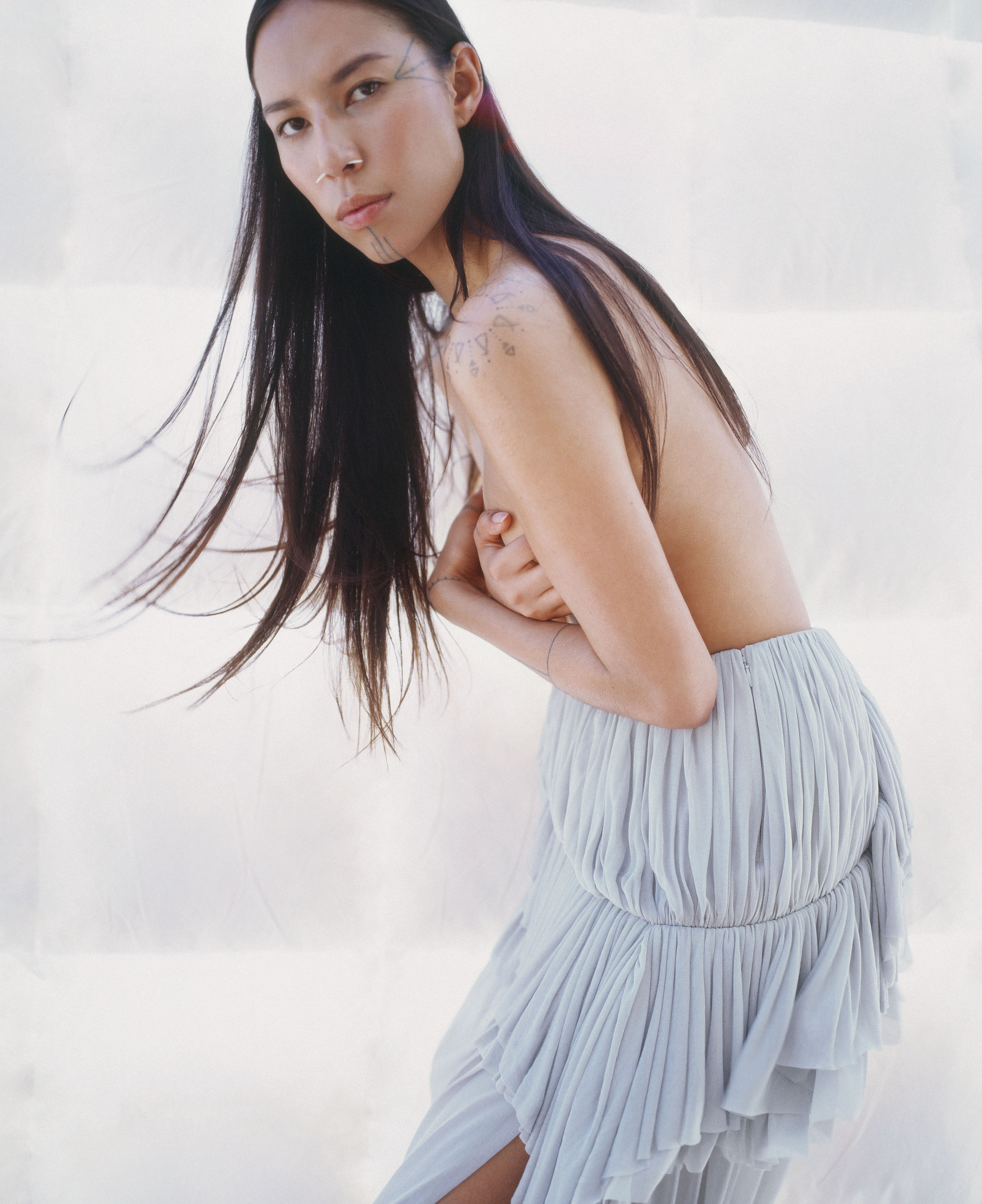
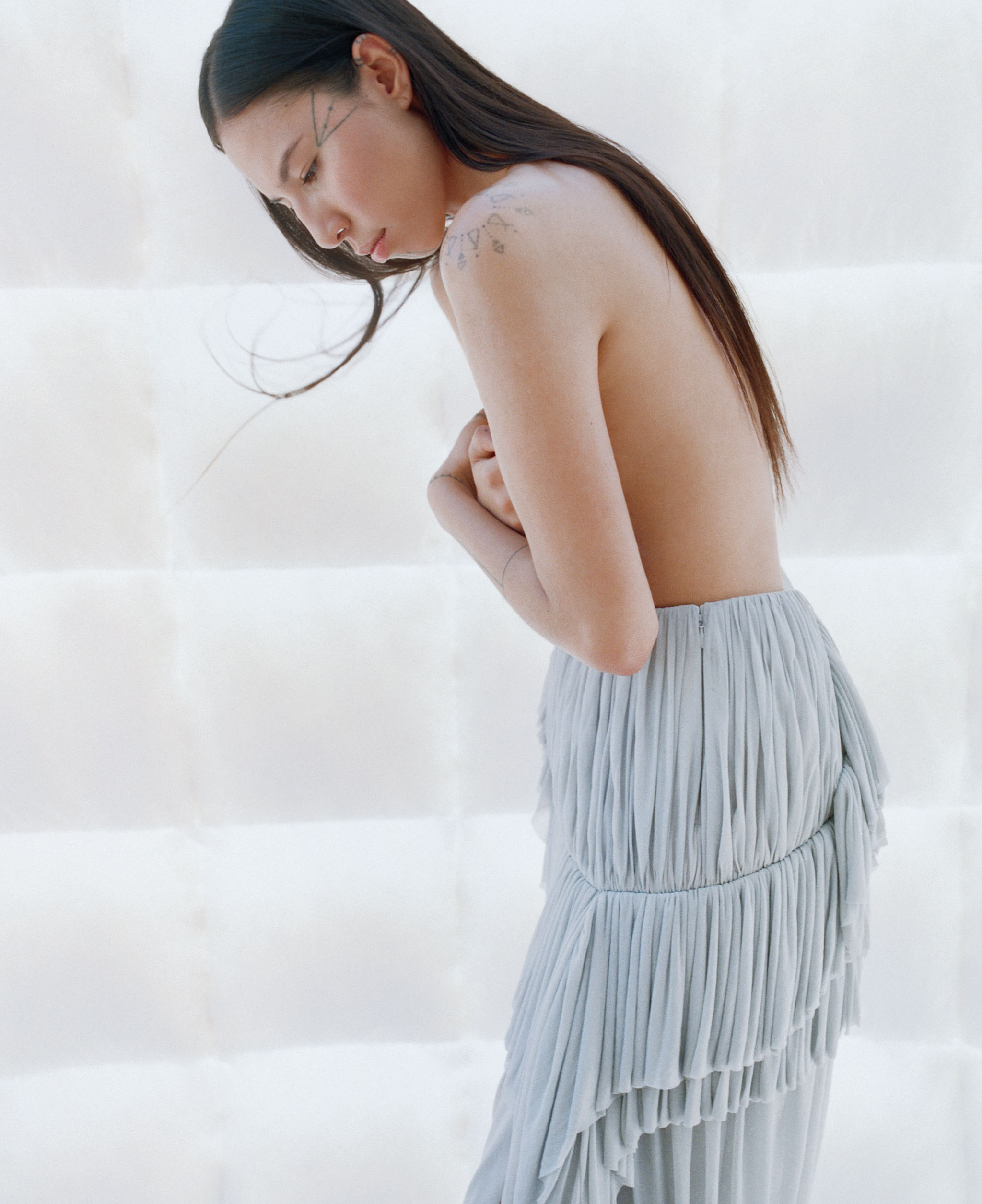
Despite the overwhelming exhaustion, loneliness and burn-out she feels, ChasingHorse remains steadfast in her pride at being able to share the beauty of her Native peoples. Working to dismantle their false and harmful misrepresentation throughout fashion and film, far from a monolith, she diligently educates her audience on their rich individual art practices, cultures, languages, mythology and regalia. Holding powerful and sacred meanings, her traditional names of Taah’ Trinja Hodek, meaning ‘feather woman speaks,’ and Wokopeka wi, meaning ‘she who makes them afraid,’ represent specific rites of passage within her maternal and paternal tribes. Likewise, her striking mother-of-pearl nose bone tusk and traditional hand-poked facial tattoos, or Yidįįłtoo, represent her Gwich’in heritage. Given to her in ceremony by her mother, she credits the women in her life as a source of guidance and wisdom, praising their ability “not just [to bring] life into this world but [to continuously give] life.”
Whether Caribou hunting in Alaska, lobbying Congress in Washington, D.C., talking with financial institutions about defunding the oil and gas industry in New York, shooting for Vogue, walking for Chanel or attending the MET Gala, ChasingHorse relies upon the wisdom of her ancestors, bloodline and lineage to move through the world with a compassion, dignity and “wide consciousness” applauded by Russell. Now one of the prestigious event’s regular attendees, in 2022 ChasingHorse attended the In America: An Anthology of Fashion—Gilded Age themed MET Gala. Describing a traumatic period of Native history marred by violent policies of enforced assimilation, genocide and removal, she used the MET Gala carpet as an opportunity to make a powerful statement. Enveloping herself in Indigenous pride and uplifting Native artists and designers, she paired a breathtaking aqua tulle Prabal Gurung gown with an intricate tipis applied with beads on smoked hide, dentalium shells and porcupine quills in traditional colours. Gifted to her by Indigenous men and women, she also wore eagle feathers in her hair to represent Native people showing up for one another.
Rooted in her Indigeneity, ChasingHorse approaches this interview as yet another opportunity to highlight important causes such as the Missing and Murdered Indigenous Women and People (MMIW/P) crisis, encouraging her audience to remain compassionate enough to use their privilege and resources to speak up.
No, you’re good. [Both laugh]. I don’t know anything about zoom.
I just hop on and press the mute and unmute button. [Both Laugh]. Anyway—
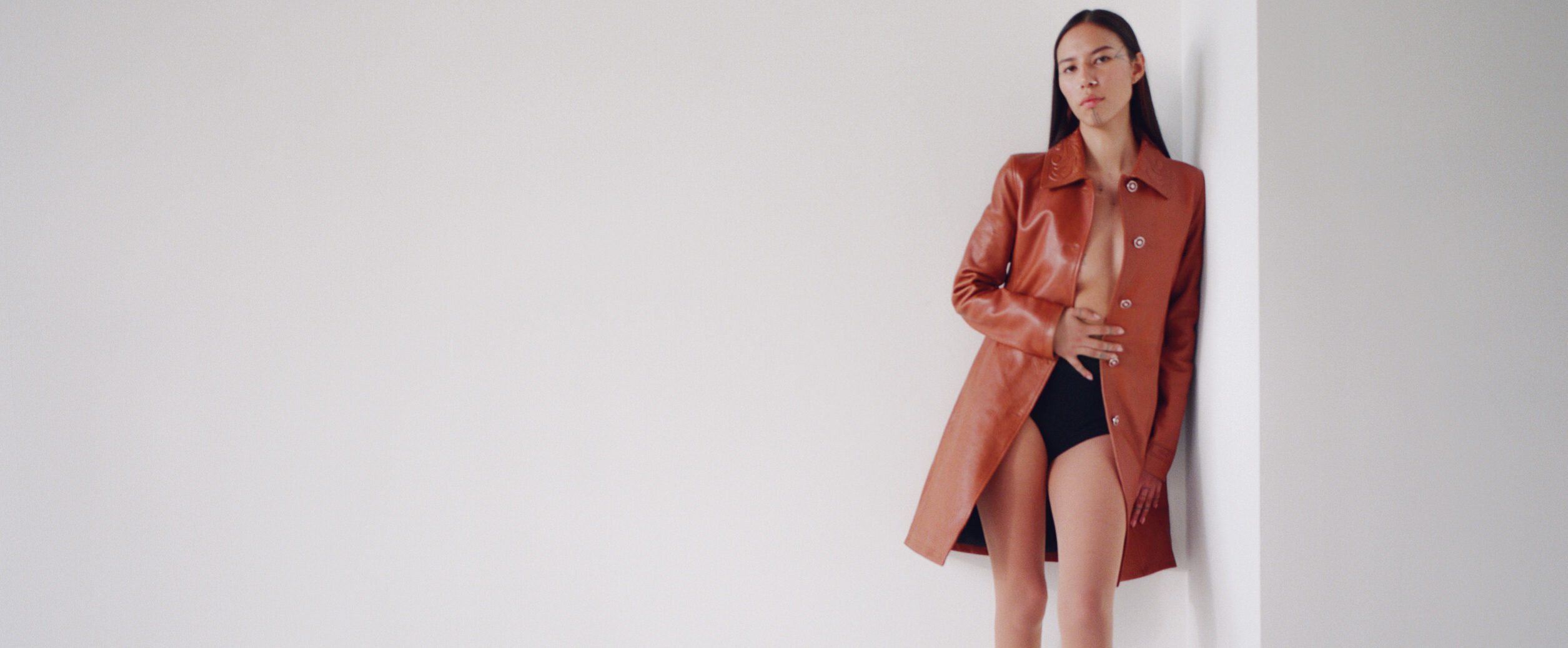
This industry is constantly moving and it won’t just stop for a second, [even] when we’re like, ‘No, no, no, wait. Let me catch up!’ It’s like, ‘No, we’re going to keep going.’ So for me, I immediately start to figure out, ‘Okay, how do I schedule around that?’ And then I think about how I want to show up in that space, depending on what it is. If it’s a cover and an editorial, I immediately go, ‘How can I incorporate who I am and my Indigeneity into this?’ Because a lot of the time, they have some space to be able to incorporate or highlight Native artists or designers. And so, I’ll bring my own jewellery. I’ll bring my own things to set, just in case. I know with some covers and editorials the stylist will have a whole thing planned where they’ll get some clothes and some jewellery from a designer and they’ll be like, ‘Okay, well you have to put this and you have to style it this exact way.’ It can be very taxing for everyone on set to make sure the shot is perfect, and so, before the job I immediately think, ‘How can I show up in a way that is helpful for everyone on set but incorporate my own self and Indigeneity into this without stepping on toes or overstepping?’
And thankfully, I’ve had opportunities where I’ve had publications say, ‘We want to incorporate Native artists and jewellery. How can we do that?’ A lot of the time, outside of sitting in front of a camera and modelling, I’m actually behind the scenes doing a lot of creative work and collaborating with people to help make it happen, to help guide the stylist and even the photographer on how to capture an image or how to reach out to Native artists and designers… There are so many incredible options out there. There is so much incredible Native art and Native-designed clothing and jewellery. It was never seen as high fashion before, but it’s now becoming that—in my eyes, we’ve always been high fashion. A lot of our materials are just so intricate and beautiful and raw and tell a story. And so, a lot of my preparation for any job is thinking, ‘How can I incorporate that?’ ‘How can I show up authentically?’ ‘How can I take this time and space to connect with these people?’ Because a lot of the times I’ve been on set, I’ve had people say, ‘I’ve never worked with a Native American’ or ‘I’ve never talked about or learnt about Native Americans.’ I spend a majority of my time on set educating people—and at the end of the day, it’s very taxing for me. But it’s worth it…
The women that raised me really made sure that I knew and understood that my words [and] the way I treat people, have power. That when I show up on set, I’m one of the only—and thank God I’m not anymore, there’s a lot of Native models that are booking jobs and there’s more representation, but there was a time when I was one of the only—if not the only Native on set. There were times were I was like, ‘I don’t want to talk today. I don’t want to answer all these questions.’ But then I would reflect and think how beautiful that is, to be in that position. To have a platform, to have influence in a way, where I can share the truth and represent who we truly are… I was raised by such powerful and strong women but that’s also who I surround myself with. The people I surround myself with are strong, smart, courageous people who are brave and who fuel my fire because I can’t be the only one fuelling my own fire. I’m inspired by so many people, and this industry is extremely inspiring! You can speak so much through fashion, and so, the whole process for me is getting into that headspace and just walking that path and staying focused. It’s such a blessing to be able to reflect. A lot of people, they get into those spaces [and] it’s all exciting but they forget that, as much as it’s fun and exciting, it’s still a job. There’s a level of professionalism but also personalism that I try to bring to it.
Of course. There’s quite a lot of people that I look up to. I feel like most of them are in the environmental justice [and] social justice space, because at the end of the day, there’s not a wide variety of models that are involved or that are as vocal. There are models that will post something on their story, but that’s just a post. There’s no organization there. I think there’s a lack of—I wouldn’t say compassion, but understanding that the platform that we have is so important.
There are a few people that I would watch, or like you said, that I would see clips of on TikTok speaking or whatever it is and feel inspiration from where I’m like, ‘That is how I want to do that!’ For me, this might sound cliche but genuinely the way Michelle Obama carries herself despite the bigotry, despite all of the [prejudices] that she has to deal with as a woman of colour. She’s so graceful in how she handles those things and how she presents herself and how she shows up in this world. And so, whenever there are any big, important speeches that I know I have coming up, I will always watch one of her speeches because, not only is she someone who has that compassion, who understands the struggle, but she is educated and intelligent enough to speak on it. Someone that I listen to that has passed is John Trudell. He’s a badass warrior from the American Indian Movement (AIM) days. Whenever I know that I’m going to be on a red carpet and they’re going to be asking me questions and doing interviews and I’m thinking about all the people that I look up to, it makes me want to stand in front of the camera and say what I came to say. A lot of times, people will get intimidated by it and will shy away from those conversations, but I’m not one to shy away!
There are a few other people. I’m not going to lie—my mom, even though it’s so easy to be like, ‘I look up to my mom.’ But genuinely, she has had some incredible keynote speeches. I learnt everything from her, the way she carries herself. I love listening to her speak because she’s so smart and she can articulate things that not a lot of people can articulate in a way that is so compassionate but also compelling. I feel like a lot of women of colour in this generation—even back in the day, but specifically today with the current administration we’re under—we’re kind of seen as people who should just be quiet. It’s a man’s world we’re living in. All the women that I was raised by and around are the opposite, quite literally the opposite. It’s their world and they have proven and shown that to me…
And so, I feel like the three people that came to the top of my head were Michelle Obama, John Trudell and my mom. [Laughs].
And lately, because of everything that’s been going on, I watched this movie called The Trial of the Chicago Seven (2020). It’s based in the 1950s when Fred Hampton was murdered. So, I’ve been in this mind space where I’ve been really inspired by Malcolm X by all of these incredible—I would call them warriors because they’re people that have lost their lives [on account of] the way that they have held themselves publicly. And, of course, Martin Luther King. Black History Month was just here so I’ve really been putting myself there and standing in solidarity.
Exactly!
This was the one question where I was like, ‘I’m going to have a hard time answering that.’ Because I’m always going to say to my mom, that’s always going to be the answer for me.
But if it wasn’t my mom—[Laughs]. It would be Deb Holland or it would be Jane Goodall or it would be… Acosia Red Elk. She’s not super well-known within the fashion space but in, we call it Indian country, in the world of Native America she’s a 10-time world champion jingle dress dancer. She has done so much beautiful advocacy work. She does a lot of youth work and health and wellness work, and I feel like she is somebody I have continuously looked up to when it comes to healing, community healing, wellness. When I think of community, she comes to my mind because she embodies community in such a beautiful way. And so, any time I think about being on the cover of a magazine with somebody or doing something with somebody, it’s always a powerful Native woman or a woman. Despite what this world pits against us—our healthcare, everything is constantly being taken from us—as women we’re continuously giving life. It’s not just bringing life into this world and having that ability, but ‘giving’ life. There’s something so sacred about the connection a woman has to this world, to this Earth, to her family and her community. As much as there are also a lot of influential men that I look up to, they’re never the people that I turn to. So, I’m definitely always saying my mom!
One day.
I feel like, yes. In a sense they have remained the same but there are two things that I feel like have really changed for me.
In the beginning, it was so lonely. I felt like I had the world on my shoulders, carrying my community with me everywhere I went—and it was never a burden, but it was always something that I felt responsible for. I mean, [even] the first question, I felt like, I had to show up in a good way. I think about that a lot. I internalise it, probably too much sometimes. [Laughs]. At the start it was like, ‘Okay, I have to do this and I have to do that and I have to do this…’ And now it’s like, ‘we.’ My mindset completely changed because [before] I truly was one of the only Native Americans. Don’t get me wrong, there have been and there are Native Americans in this industry but, because of the way society has painted us to be, a lot of people hold a lot of shame. And also the way assimilation has played a huge part in erasure, whether [through] separation or whatnot. There’s a lot of people that have Indigeneity but didn’t live that way, didn’t grow up with that, don’t know much about it… Now, there are more Natives in these spaces and more people being like, ‘You know what? I am Native, and I should be proud of that.’ Who do not shy away from those conversations, do not allow [their] identity as a Native person to be taken away by the way other people see [them]. I have seen harmful representation, false representation, misrepresentation of Native peoples throughout fashion and film—forever. And so, to be able to be a person that can shift that narrative, that can reclaim [that narrative], that can show the world that we are not a monolith, that we are not all the same, that we come from communities that share the same values but we have different languages, different cultures, different art, different styles, different regalia, [it’s a beautiful thing]. There are so many things that separate us but so many things that connect us. So, I think for me, it’s the idea that it’s less of me carrying so much of that work myself. Now, we’re seeing so many more Native people taking up space, proudly… And so, [I love] being someone that can inspire other people to love who they are, to appreciate and really fall into the love of our community—because a lot of our people push that away.
There’s so much shame and stigma around Native communities because of the things that we face like addiction and suicide and the Missing and Murdered Indigenous Women (MMIW) crisis. There’s so much harm there, but that’s not what makes our community what and who we are. Our joy, our beauty, our ability, despite what we’re going through, to come together and support one another. There are so many beautiful things about our community. Hollywood and fashion fully make us seem like we’re just the Indians at the end of the barrel of the gun of a cowboy in every movie. You know what I mean? I’m tired of seeing Natives being killed by cowboys, I’m tired of us being the bad guys or being ‘savages’ or being seen in a way that wasn’t the truth. Our homelands, our people were being killed, were being taken and slaughtered. There’s so much undoing there that I’ve been able to see and so much beauty coming of Indigenous people. Before, it was so many derogatory terms, so much trauma porn. That’s all we’ve seen of Native people throughout film and throughout fashion. And of course, the monolith of all tribes having headdresses. You would see fashion using headdresses when that was one of our most sacred garments, when not everyone was allowed to wear or even touch a headdress. It takes away from, not only the meaning, the depth, the sacredness of it, but it turns us into a joke. And so, going from being a joke to becoming an actual prominent person in fashion, when I go to the MET Gala I always take up that opportunity to bring in Native artists and designers so that people can see that we’re not just feathers and beads. We’re so much more. To see so many more Native models being signed and represented and walking runways and doing photoshoots and more Native designers taking up space and opportunities, it is such a beautiful thing to see us now becoming a part of this industry rather than a joke or something that they can talk about without us… There was a lack of Native representation and it was always just stereotypes and people fitting us into this box. Any woman of colour would go into a shoot and they would be like, ‘Oh my God, you look like Pocahontas!’ And then throw a headdress on you… And so, going from that to now having [someone like] me on set, authentically showing up and showing who we are and telling the story of Matoaka—because Pocahontas wasn’t even her real name, Matoaka was her real name. I feel like representation has become more real for us because it was always this fake idea of these people from the past, when we’re still here. That’s something that I have continuously said and that’s been my statement always at every big red carpet. That we’re still here. As much as you want to forget that we’re here and treat us like we’re non-existent, we can see what you do, we can see what you say, we can see how you treat us. With my platform, I have such a beautiful opportunity in this world and in this lifetime to shift that narrative, to reclaim that narrative so that we can tell our own stories and we can create our own art and fashion lines and not have it be appropriated and taken from us—just like everything else.
I feel like there’s a lot to unpack there. [Laughs]. But it’s a beautiful thing, and I’ve seen so much growth in this industry so I feel much better about representation. I don’t feel as angry all the time by what I see. I feel a lot more enlightened because I’m like, ‘Oh, they got a real Native!’ or ‘Oh, they got an actual Native artist!’ So there’s progress being made and I feel a lot more hopeful.
[Laughs]. It actually really is.
There are times when I feel like I have completely burnt myself out into oblivion, when I feel like I don’t have it in me anymore. There have been times when I have pushed myself to where it has made it hard for me to even want to live anymore. There have been really, really low points in the last few years. I mean, as beautiful and amazing as my life is, that’s the thing about Natives. As much as I could be at the MET Gala and it’s such a beautiful thing and I want to just be present, appreciate it and be happy, in the back of my mind I’m thinking about what’s going on back at home. And back at home are some of the most atrocious things that a lot of people that are in the same space as me can’t fathom having to go through, and so, that’s something that I’ve had to learn to navigate. Despite what I might be going through, how do I keep showing up? How do I still remain hopeful? I’ve asked myself that same question on and off because sometimes I don’t know how I do it.
At the end of the day, it comes down to the women in my life. I have a group chat of aunties that I reach out to when I really need it. It’s all of my aunties and my mom in this one group chat. I’ll even reach out to them when I have a really intense interview question, which I know I can answer properly but feel like I want or need guidance. I will reach out to them for anything and they’ve always got me. They’ve proven and shown to me that, no matter what I’m going through, they will always show up for me when I need because they know that I’m showing up for my whole community, they know that I’m going to need that strength. I do spend a lot of time back at home, I do have the immense privilege to be able to go home. And there have been beautiful [moments] in my career where I have had the ability to also bring these projects and bring these jobs and bring these people to my home. It’s such a beautiful thing to have these experiences, but to also be able to bring my community with me and my family with me. Or bring the industry to my community and to my family. I’ve had opportunities where I’ve been able to do both. It’s been a learning journey for sure, but it’s [about] communication, reaching out and being open-minded enough to allow myself to feel what I’m going through and be patient with myself but also allow myself to hear other people and their perspectives.
I do have my personal things that I do. I have my sage here that is harvested from back home that my family gives me. I have my sweetgrass. I have my traditional medicines that I use and I pray with that can help me feel realigned. For a lot of my environmental and social justice [work], it can feel lonely. It can feel isolating, it can feel very overwhelming—especially with this current administration. We went from feeling confident that we were going to come to a point in time when we weren’t going to have to constantly fight for things and repeat ourselves over and over again to [now this]. I’m the fourth generation of my community to have to fight against the Government to protect our sacred land in Alaska. The fourth generation, that’s too many generations! We thought that with the Biden administration there were some improvements. We were like, ‘We’re moving forwards.’ It’s nowhere near where we wanted to be or where we needed to be, but there were some protections being put forward and being put in place that made me feel confident that my children or maybe my grandchildren would not have to fight this fight. But with this administration, everything that we worked so hard for since I was 13 crumbled and I had to grieve everything that we had worked for in that space. It feels hopeless sometimes, but the thing that gets me back on my feet and back at the protests is when I see Elders that have been doing this work since they were my age, and then I look over and I see children who are listening, who are watching, who are paying attention to the world that is going to become their future. And so, seeing the Elders and the youth, seeing the connection there—that’s life-changing! That changes the perspectives of so many people because that is the thing our Native communities value the most, the relationship between our Elders and our children. I spend a lot of time with my Elders…and my dog. [Laughs]. She wants me to play with her, she’s been patiently sitting here waiting for me to finish.
She really is. She’s very responsive, she’s so smart. I love this girl.
But yes, it’s definitely spending time with my Elders and spending time with the youth and realising they’re so fucking smart! We’re not giving enough credit to these kids for being as smart as they are, because as much as the education system at schools is nowhere near where we need it to be and there’s so much going on in the education system right now, these kids are going out of their way to learn these things. That’s something that I was doing at their age, but I forget that we have the world at our fingertips. We have phones, we have the internet. So, just seeing where these movements are going, who’s showing up. It gives me hope. It shows me we have something more to fight for.
[Laughs]. Well, actually that is something that I think about a lot.… This year, I skipped fashion week. For one, there were other reasons why I skipped fashion week but I was like, ‘There’s a lot going on in the world. I need to lock in on my advocacy work.’ At this point, the majority of my schedule is already me going to D.C. lobbying, me going to New York, not for fashion, but to talk with financial institutions about not funding the oil and gas industry. A lot of my work this year is going to be advocacy work. I’ve realised that, as much as fashion has such influence and it gets me paid and I love it and it’s so fun, it’s not what’s needed right now. We’re not saving lives out there, we’re selling clothes. And so, I had to be like, ‘There are 1,000,000 models that could sell clothes. There are not enough people, not enough models and influencers, talking about what’s going on in this world.’ And that’s the thing that really, really irks me the most, is people knowing that they have a platform, that they have influence, that they have people who would stand by them regardless of what they say and not utilising that as a tool to speak on things that need to be spoken about. That is a privilege, a privilege that I don’t have. It’s something we were talking about earlier. As much as I want to be like every other influencer and not have to talk about these things, I do because these are things that are greatly affecting my community. They’re affecting my family, they’re affecting the people I love and the place that I grew up.
And so, building that bridge and closing that gap in environmentalism and social justice work in fashion—there’s so much there that can be done. You don’t even have to say anything. It can just be said through clothing. I feel like there are so many opportunities in fashion that people aren’t taking to create something really meaningful, not just another micro-trend that everyone is over by the next week, but something that is sustainable and tangible and long-lasting. As much as this sounds so silly, my dream is to do campaigns with Chanel or Versace. I’ve worked with Chanel a lot in the past, but to actually collaborate with these high fashion houses on a sustainable line where we hire activists and people of colour in these spaces. I feel like Stella McCartney does a pretty decent job, but imagine if it were Chanel or Versace… That could inspire so many people, that could change the history of fashion. With the kinds of influence these houses have within fashion, within the world, they could really do something with that. I am constantly dreaming of the day when someone gives me the opportunity to collaborate with them and create something so beautiful that can also give the house longevity—because at the end of the day, if we’re not moving together where are you even going? You know what I mean? What are we even doing? So, I’m constantly thinking, ‘How can I challenge people to create these opportunities…?’ So, that’s where my mind goes.
And it’s so real, because at the end of the day, I wish people who had that privilege could see outside of their own perspective and be open-minded enough and compassionate enough to stand with us and understand that they have, not just more privilege, but more access to resources that could really help in so many movements.
Thank you—you as well. When my agent told me that they were talking with you about this I was like, ‘Oh, how fucking awesome.’ It’s refreshing because you’re also someone who cares and says stuff and doesn’t shy away from conversations so it’s always so inspiring, but also, it gives me even more motivation to see that there’s more of us who actually care in this industry. I appreciate you taking the time and sharing a space with me and speaking with me about these things.
Yes, for sure… It was nice to meet you in person and I hope we have the space and time to meet again and to get to know each other better.
You too, thank you.