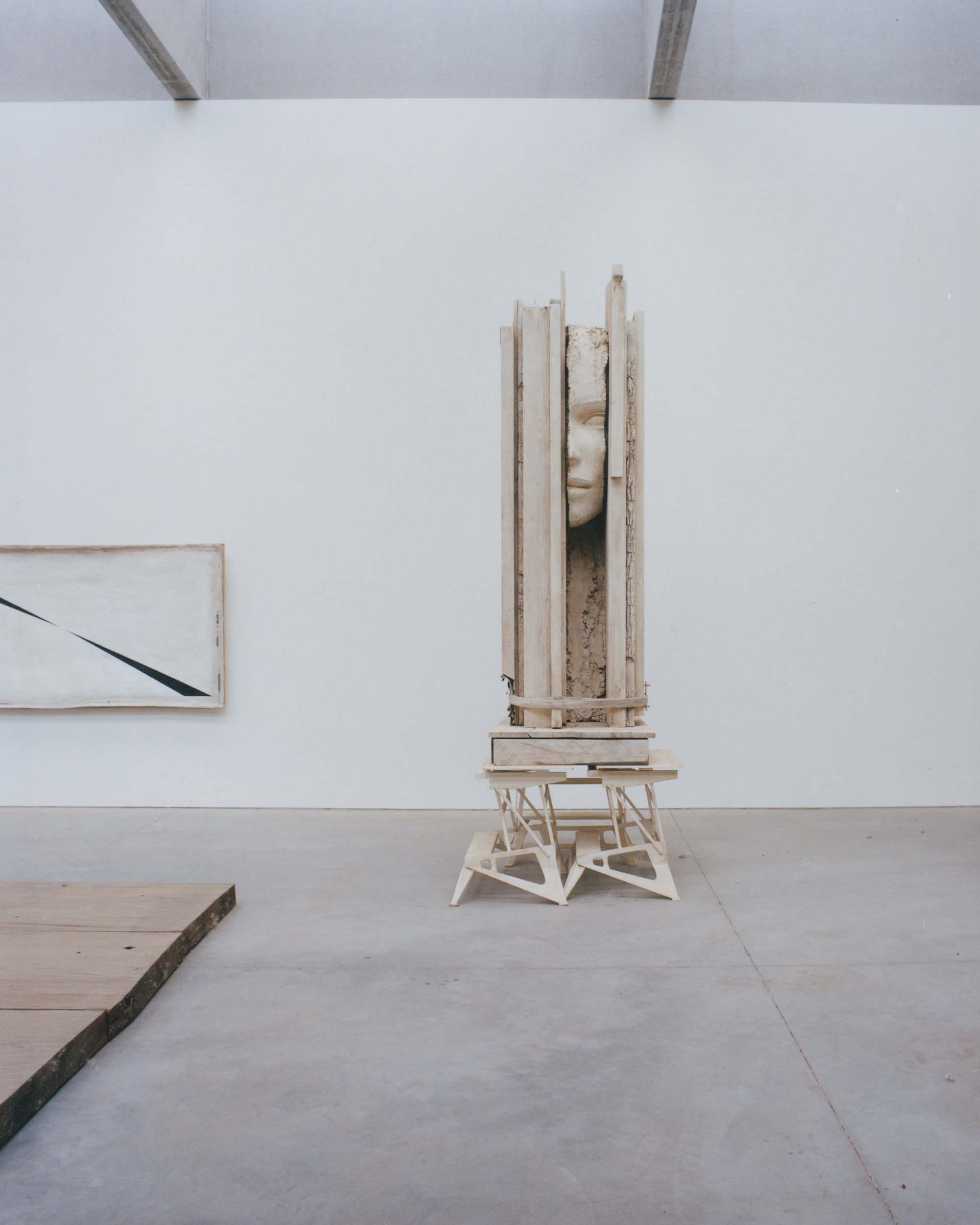
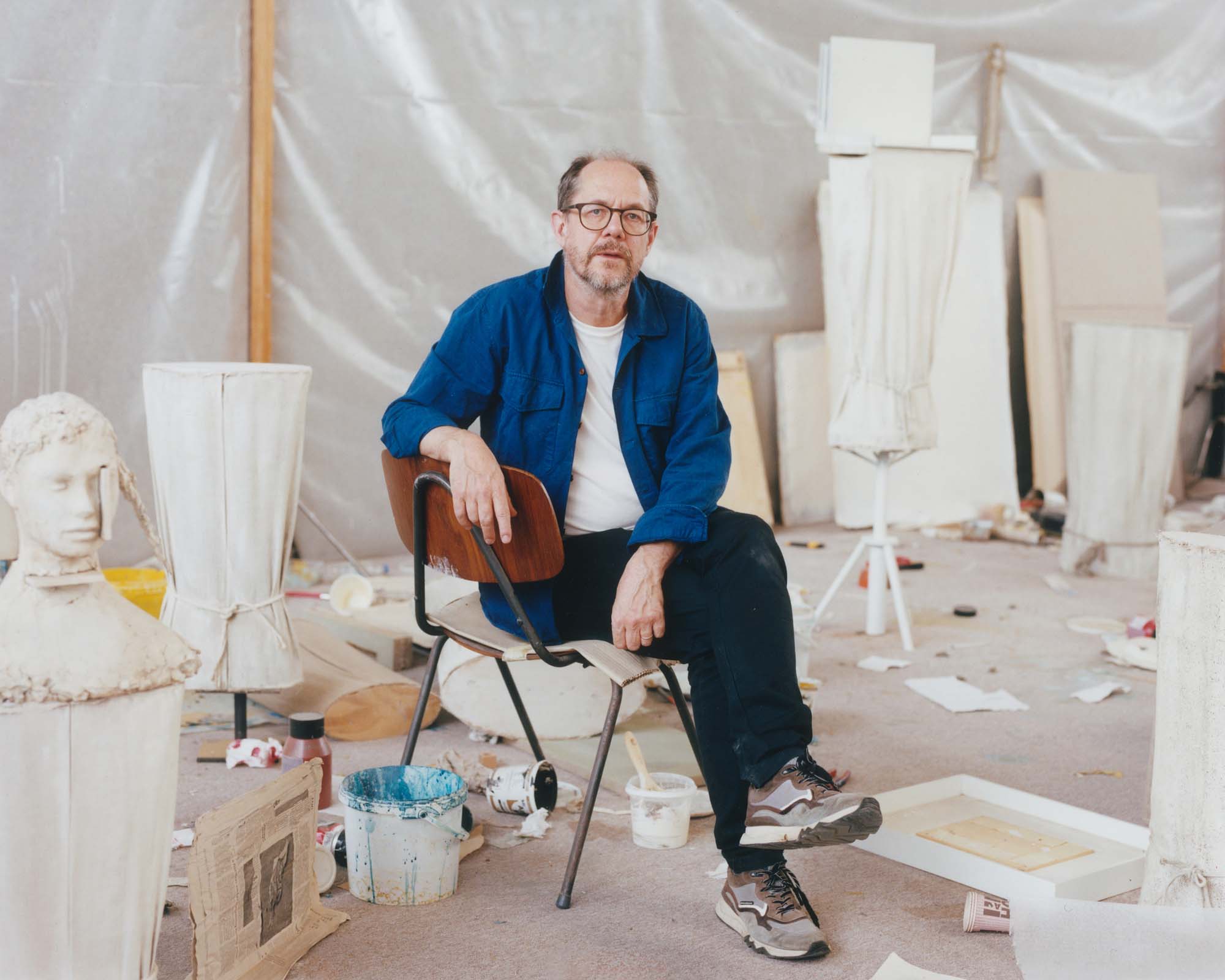
Mark Manders became an artist 40 years ago, when, in 1986, he began a lifelong artwork: Self-Portrait as a Building (1986–). This building was not to be a physical space, but one which would exist in the artist’s imagination and take form across multiple media. A floorplan for Self-Portrait as a Building, for example, is composed of the writing materials the artist had to hand (pencils, pens, paints, rubbers, scissors), and in the words which accompany, and thus, contextualise, the conceptual nature of this work. As such, Manders’ work defies easy categorisation. It often takes the form of sculpture—from monumental, classical busts such as Bonewhite Clay Head with Vertical Cloud (2024–25) to site-specific installations such as Silent Factory (2000), which Manders has described as “a cross between a living room, an organism, and a factory.” [1] There is something familiar, yet ultimately unplaceable, to site-specific works such as this.
Manders makes many of the objects that appear in his installations himself, sometimes scaling them down to 88% of their “typical” size. To move around an everyday object that is smaller than it should be, but not obviously so, has something of the uncanny about it. In doing so, the object—and by extension, those encountering Manders’ work—become somewhat detached from reality. The ongoing and ever-evolving project that is Manders’ self-portrait is thus suspended somewhere between the “real” and an imagined world—hovering between memories, images, words and objects that exist in the mind, and which Manders fixes in place. This vague familiarity appears as fundamental to the total environment of Manders’ practice: Self-Portrait as a Building, and the concepts that Manders develops through it, have become the basis of an expansive body of work that veers little from its original formulation.
Much of what Manders explores today can be traced back to his formative years as a nascent, yet arguably fully-fledged, artist in the late 1980s and early 1990s, during which time he studied at the Hogeschool voor de Kunsten in Arnhem, the Netherlands. It was, for instance, in his final year of art school that Manders, having decided to work with every material available to him, turned to ceramics. Speaking over Zoom, Manders recalls that he wanted to make the most basic object one could with clay, landing upon the idea of “making” a baby with Lucas Cranach’s Venus (1532). But when Manders fired the ceramic baby, it lost the malleability, and thus fragility, that the artist had found so compelling in the wet clay.
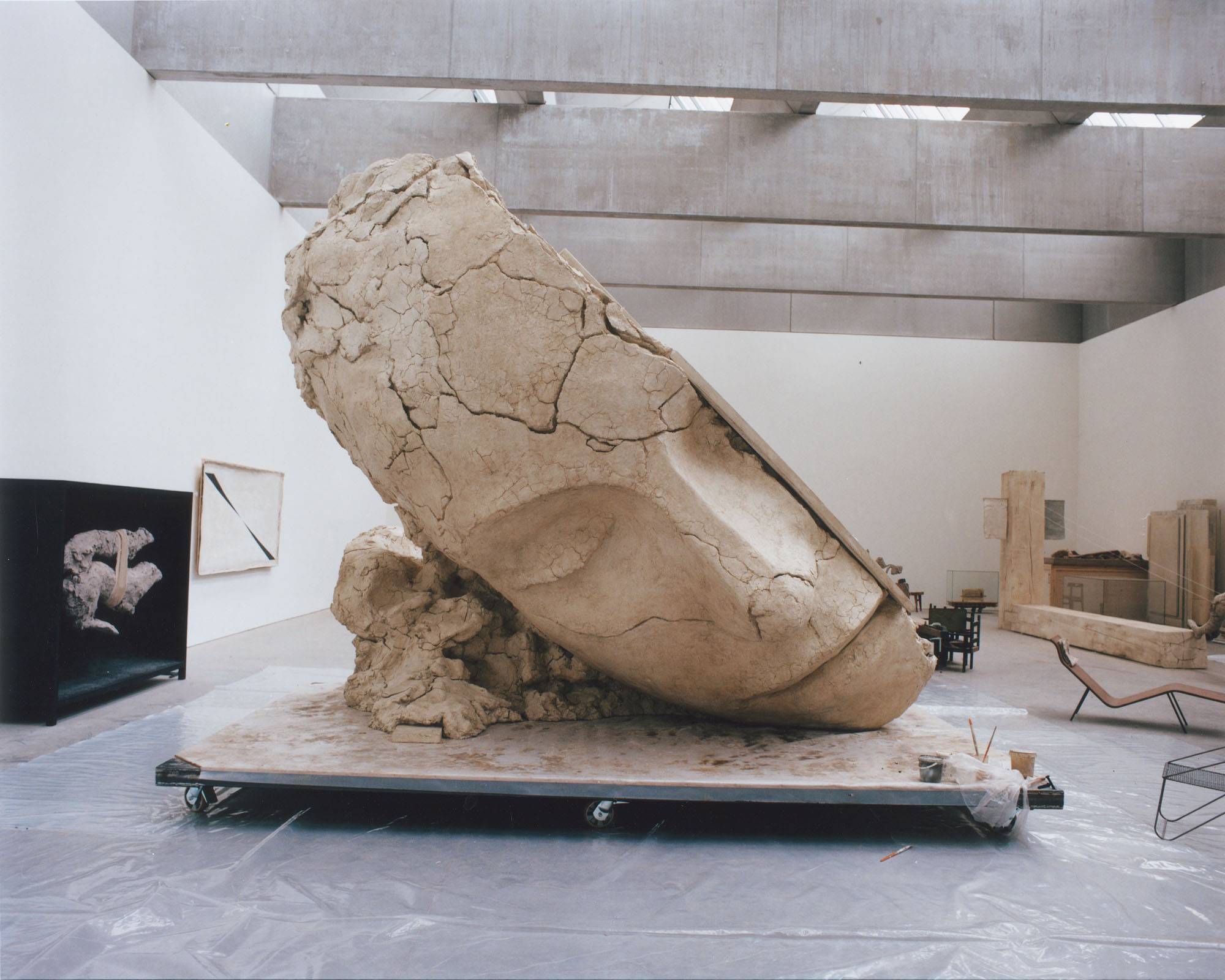
From there, Manders began casting works in bronze such as Fox / Mouse / Belt (1992–93). and painting them to look like wet clay. “I really like this feeling that you could imagine somebody still working on it, but that this person was absent,” he explains. “And that if this person came back, they could change something again.” These bronzes appear as if frozen, but what of the inevitable, unavoidable passing of time? After casting these wet clay bronzes, Manders kept the moulds in his studio, which, over time, “dried and cracked, and became super fragile.” This would inspire Manders to begin casting bronze works that look as if they are dried-out, cracked and dusty clay—capturing what Manders describes as “the most fragile moment of this material.” Monumental bronze busts such as Tilted Head (2019) evoke a lightness, as cracks and fissures form along the sculpture’s visage. Even then, all is not what it seems: seen from the reverse, two chairs, cast in bronze as part of the work, lift the weight of what appears to be dense, heavy wet clay.
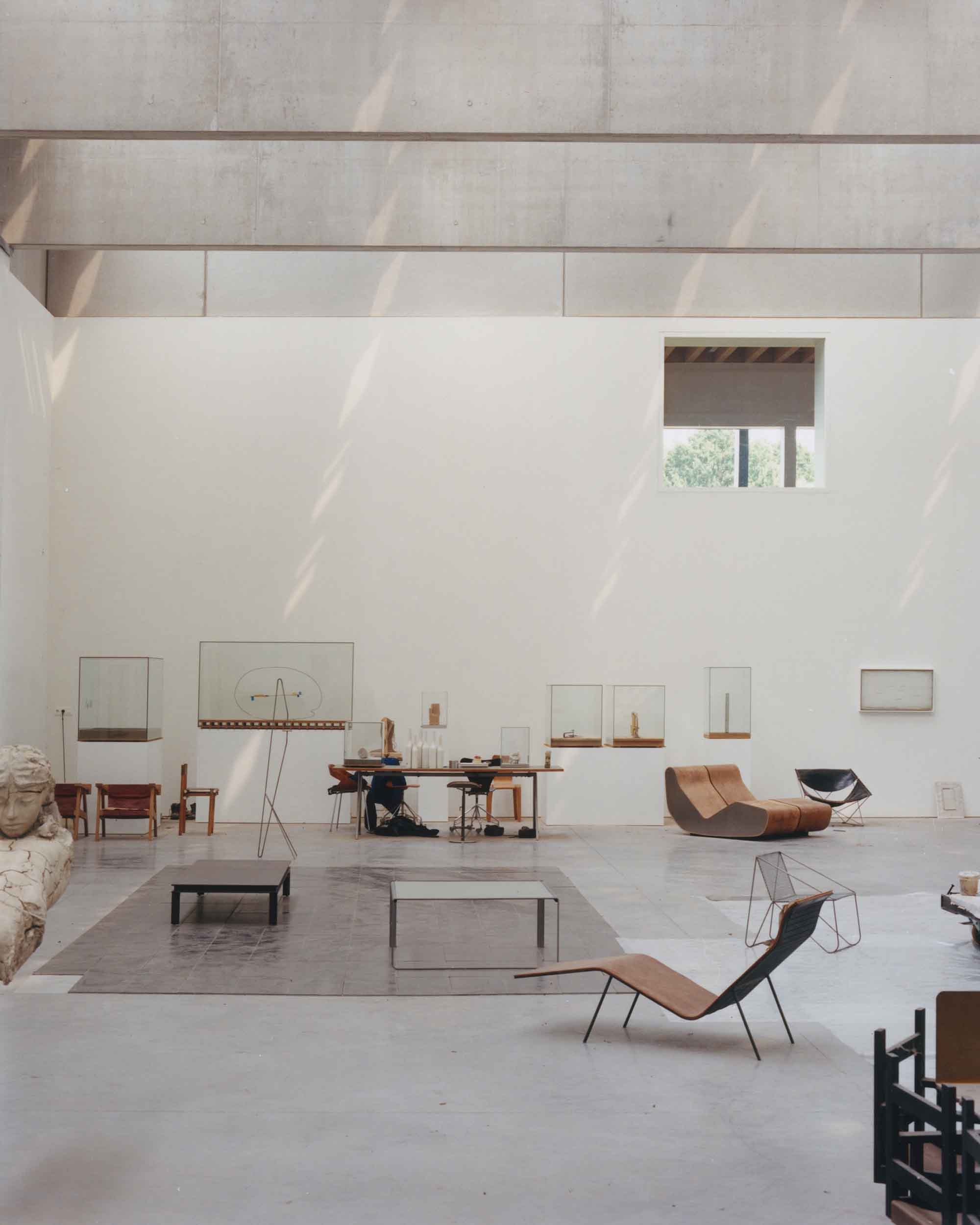
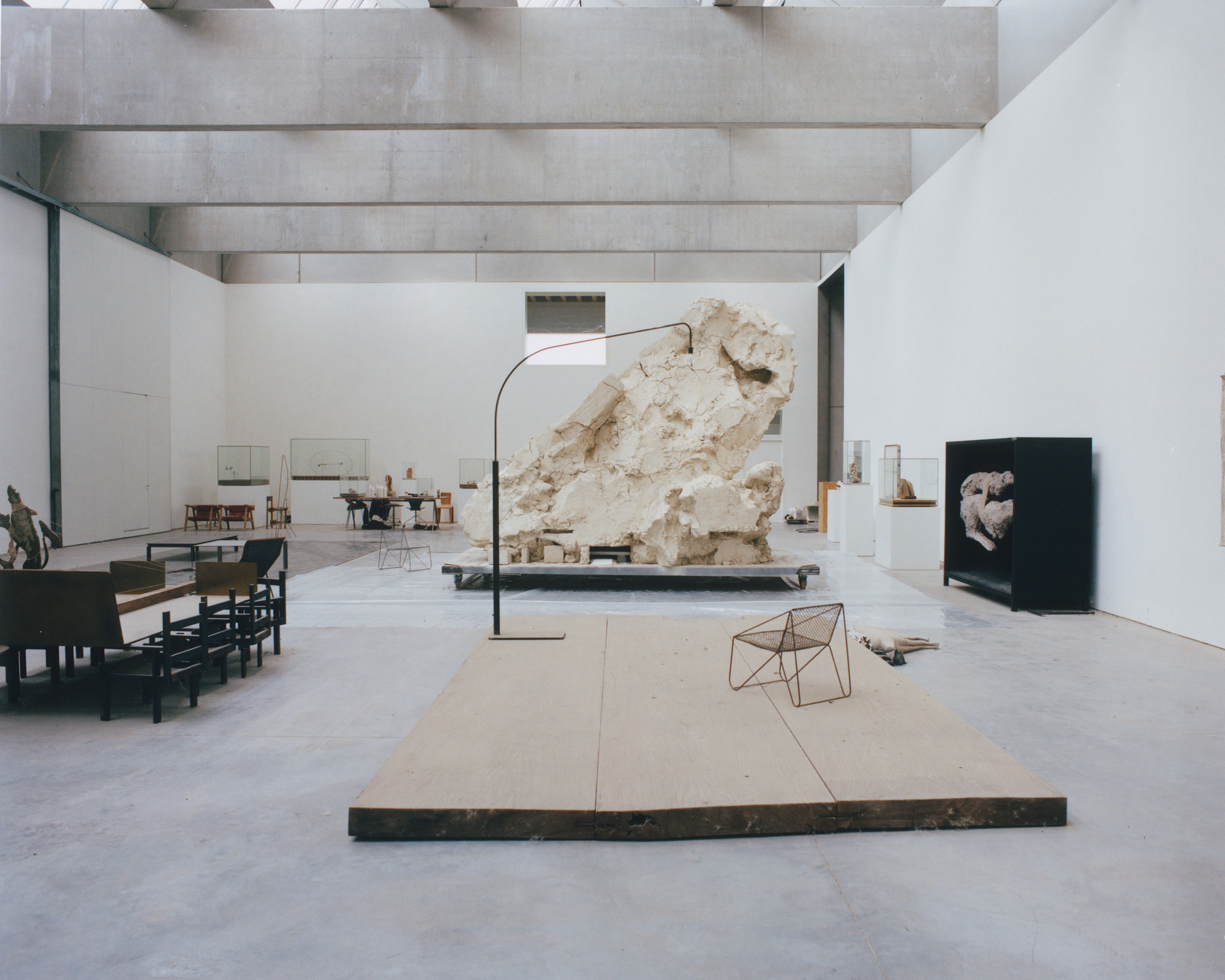
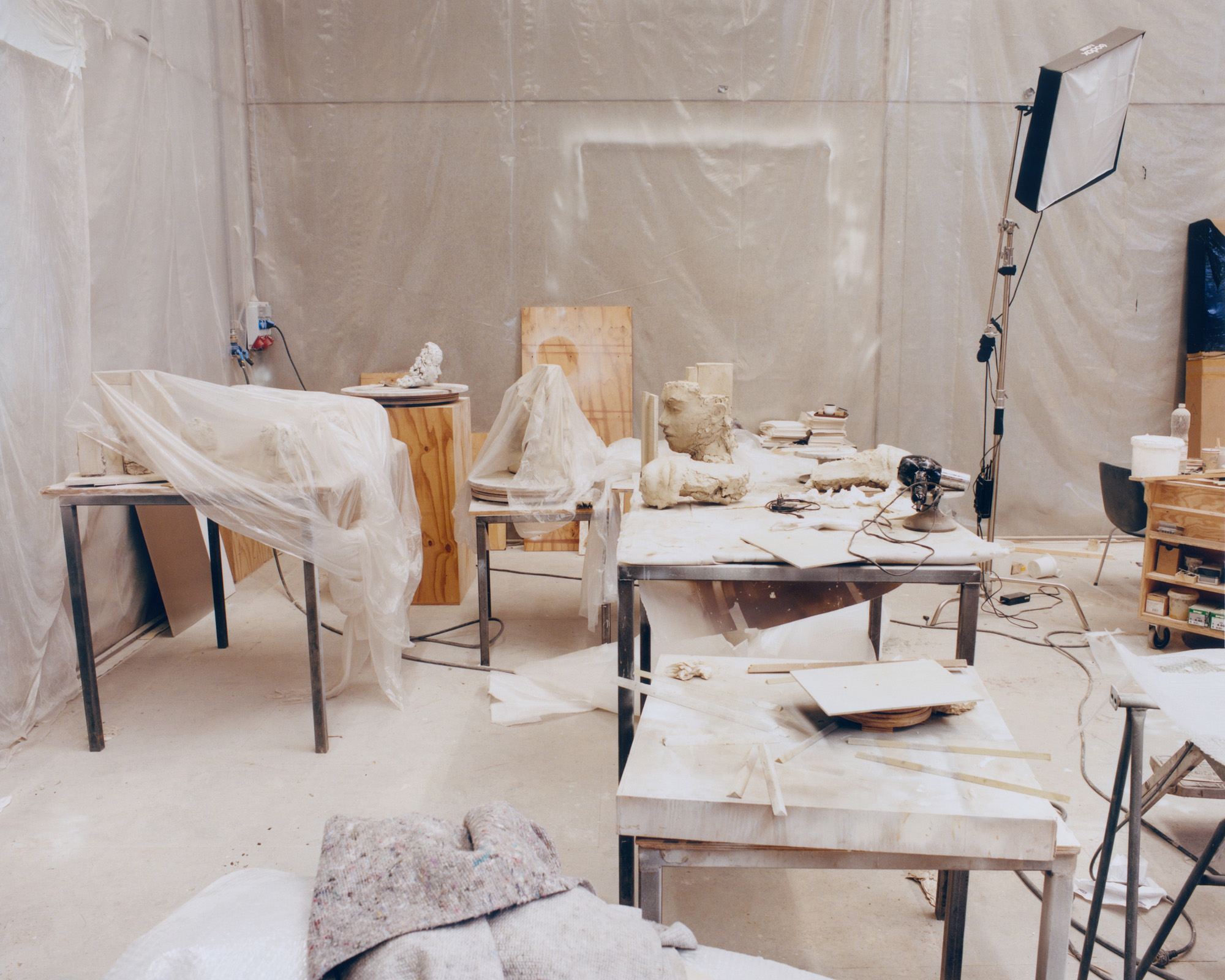
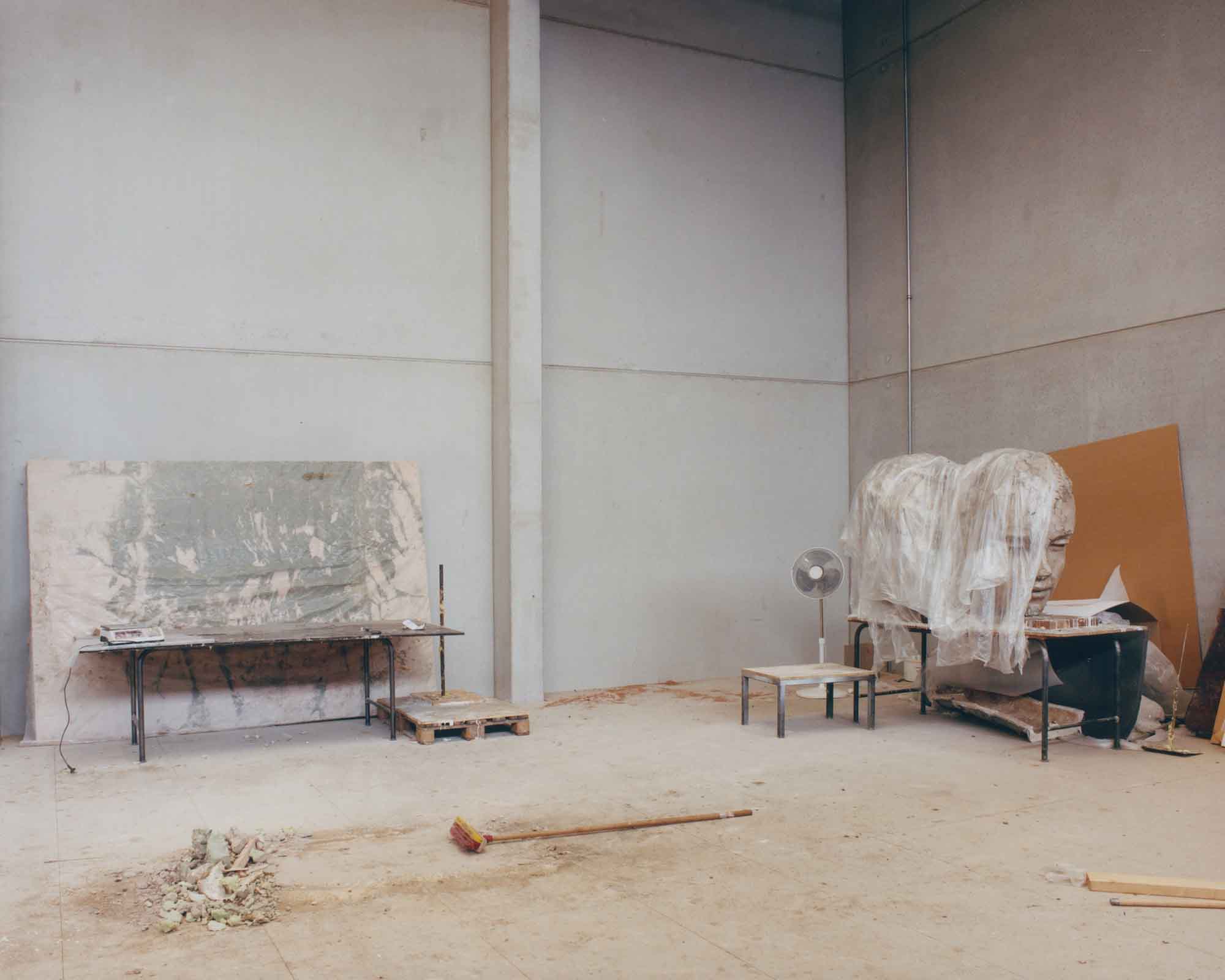
In “The Absence of Mark Manders” (1994), the artist writes: “The realisation that life is taking its course, even without you, is an intense human experience; it shows the finiteness of personality.” Manders, who has inhabited his Self-Portrait as a Building since 1986, is reminded that this “building” can expand or shrink at any moment. The “building” arises, like words, out of interaction with life and things,” [2] and in this building all words created by mankind are on hand. If Manders’ self portrait exists through words, objects and images, then it is in Ronse, Belgium, that the artist resides. There, Manders works across two cavernous studios in a former textiles factory, in which rooms and spaces unfold in a way not dissimilar to the conceptual building at the heart of his lifelong work.
In conversation, Manders describes the ways in which he encounters problems to solve and rules to break. “In my studio, there are lots of problems,” he says. “But they are good problems. And if I never solved them in my life nobody would miss them, because nobody knows what I want to make, you know, it doesn’t matter.”
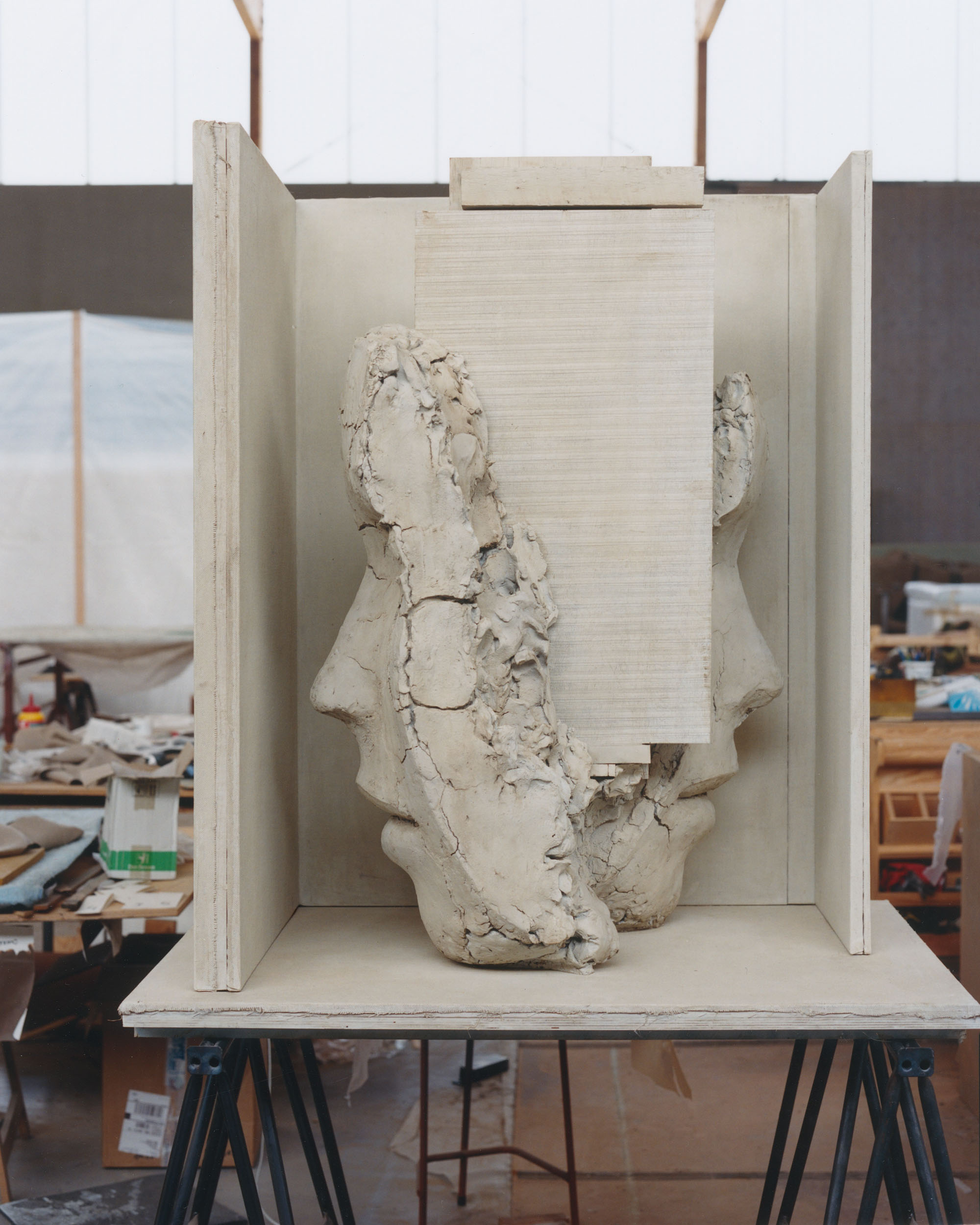
Choosing the material is almost half the work. In my studio, I have a lot of rules, and there’s one rule that I’m not allowed to use colour. For example, if I want to make a figure, if I have a need to make a work with a figure, making it with wet clay is logical. But if I make something out of clay, it will have a wet clay colour, because I want to show the moment that I make something. Sometimes, I have to trick myself to find a reason to use colour. For example, [take] Bathroom Composition with Four Colours (2010–14). In a bathroom, you use towels which don’t have a specific colour; they can [be any] colour. So if I use a towel in my work, I can choose a colour. But if I [were to] make a bath, the bath [would have to be] white… If I’m working on a piece and I need a chair, I cannot [use] an existing chair. I like to design the chair myself, in a way that you cannot place it in an exact year or period. If you see my furniture pieces, you think that you know them, but you don’t know exactly [which] period they are [from] and who made them—well, I made them, but they feel kind of timeless and modern because I’m living now. [These rules are always in my head, and I try to overstep them. That’s part of the fun of my studio.]
Sometimes, I’m fascinated by a certain material, but it’s more a language thing. For example, when I was making Silent Factory (2000), one part [needed to] be made in papier-mâche. But I cannot use a newspaper because it is linked to a certain period or place, so I had to make my own newspaper that is timeless. The first newspapers that I made [contained] only fives: five-letter words, five images of fives. I really liked this project [Newspaper with Fives (1999–2001)], but [it was’nt] really a newspaper. So then, I started making newspapers with existing words [that] are designed in a way that they look like “normal” newspapers. They contain every word only once, in a random order. I made photographs of things in my studio that don’t relate to language. They really look like newspapers, but [they’re] total nonsense. These newspapers are important [to] me, because I can take words from the newspaper and I can make other works with it. I’m really a writer of objects, and I’m very rich because I own all existing words.
I see problems as something very, very positive. I have two big studios; if I walk around it makes me happy, because there are lots of works that are totally not good but I have the feeling—or at least I have the desire—that they will become good. I’m very optimistic when I walk around my studio and see all these things that can grow into something beautiful. And it doesn’t matter if it sometimes takes five or ten years.
I have works that I can finish in one hour, but I wait for a few years to do that. There’s a work in my studio that I started 15 or so years ago—I can finish it in one day and I know it will be good, but I use this work to generate other ideas. Sometimes I think about it and I find another solution, and this becomes another piece. Suddenly, it’s the right moment to finish it.
In my studio, [there are] lots of ways to generate ideas. For example, I can finish the work and then take small pieces of wood and build a room around it, sometimes even [with] pencils or just thin pieces of wood. It really feels like a room, but it’s just a big space. Then I think about a work that could stand next to this piece in this room, and I have a problem to solve and I start making another work that talks to this other piece. I think, as an artist, the most important material to work with is desire: the desire to make.
When I was younger, I really loved the idea that when you read sentence by sentence, you’re thinking together with the writer or the main character. I started thinking about how you can make a book that you can walk through, a three-dimensional book, like a stage set—a totally frozen place where you can see that somebody did something, you can see [their] thoughts or actions. In a way, it surprises me that nobody else works like that, makes a really gigantic stage set during [their] life. For me, that’s something very logical. But it’s also something very fundamental. Ever since I was a child, I liked places where people did something and then left. I really enjoyed these places, and I turned it into my profession.
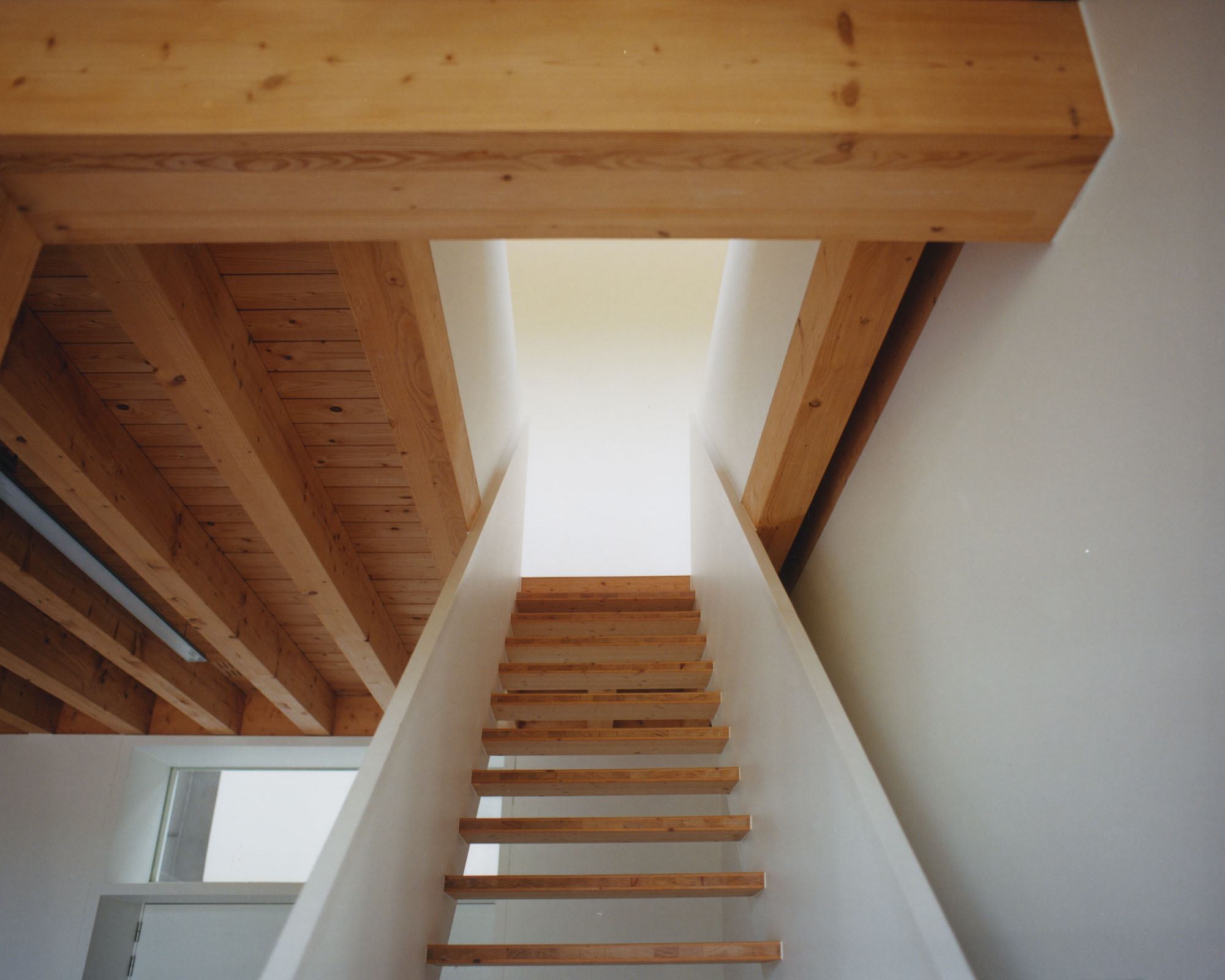
Once we started making objects, we started making tools, and because we made objects and tools, we developed language. But we also developed the idea of time. For example, if you make an axe you make something to use in the future, and so you project an action into the future. The idea of putting objects together, and that these objects talk to each other and form a total environment, is very fundamental. [During my childhood, I saw] an image of a handprint in a cave. The hand was gone, but the handprint was still there. That made such an impression [on me], that this person did this one-minute thing and we still think about it and talk about it. It’s really an image in your head…, [but] you cannot [fully] grasp it with your mind. I became really fascinated [with the idea] that you, as a human, can make an object that you can see in two seconds, and you can carry it with you in your head and it will never leave you again. How is that possible? And it can be important in your life—this object that you saw in those two seconds.
Sometimes, for exhibitions, I create studios. They’re different [from] my real studio, because in my real studio, there are things that don’t belong in my work. But sometimes the studios that I recreate have the same kind of feeling as my studio. I make a cardboard floor with plastic over it and I [install] these bronze pieces that look like dry clay or wet clay, and then there are walls of plastic—in my real studio, I also have walls of plastic—[which], if you walk through the exhibition studio, move a little bit. These rooms become very fragile. When I make exhibitions, I like that you’re in a studio room, then you step into a room that is very clean and has only one object, and then you go to another room that feels more like a living room but with all these objects. If you make a work and place it in a room, it relates to your body and the size of a work can really change the experience. For example, I’m [currently] making an installation for Broken: The Power of A Fragment [(25 September, 2026, until 24 January, 2027)] at the Fondazione Palazzo Strozzi, and all the works there are reduced to 88%. There is a very big hat at the back fixed on two chairs at 88%, but the hat is really big. If you look at the chairs, you feel like you’re bigger, but the hat is the opposite and it’s a very strange experience. A big part of the work is how it relates to a body if you stand in front of it, or go around it.
I talked [earlier] about Newspaper with Fives. At the time, I thought it was something very interesting, because I took one word or one thing [from] the world and I tried to write a poem with only [that] one word. That same idea, many, many years later, evolved into the Skiapodes project, where I took a word from [one of my] newspapers that I thought was very interesting, the word “skiapode.” I became the worldwide specialist; there’s nobody in the world who knows more about skiapodes than I do. I know everything about this word. I wrote a book about skiapodes, I made fake skiapodes, I made a Wikipedia page about skiapodes, and I made a book that can make these skiapodes disappear again, [La Scomparsa Degli Sciapodi [The Disappearance of the Skiapodes] (2023)]. It’s a very layered project, this project with only one word. And so, for me, it’s like a poem with only one word that says something about the strength of our mind, but also about the weakness of our mind, of the fragility of our mind.
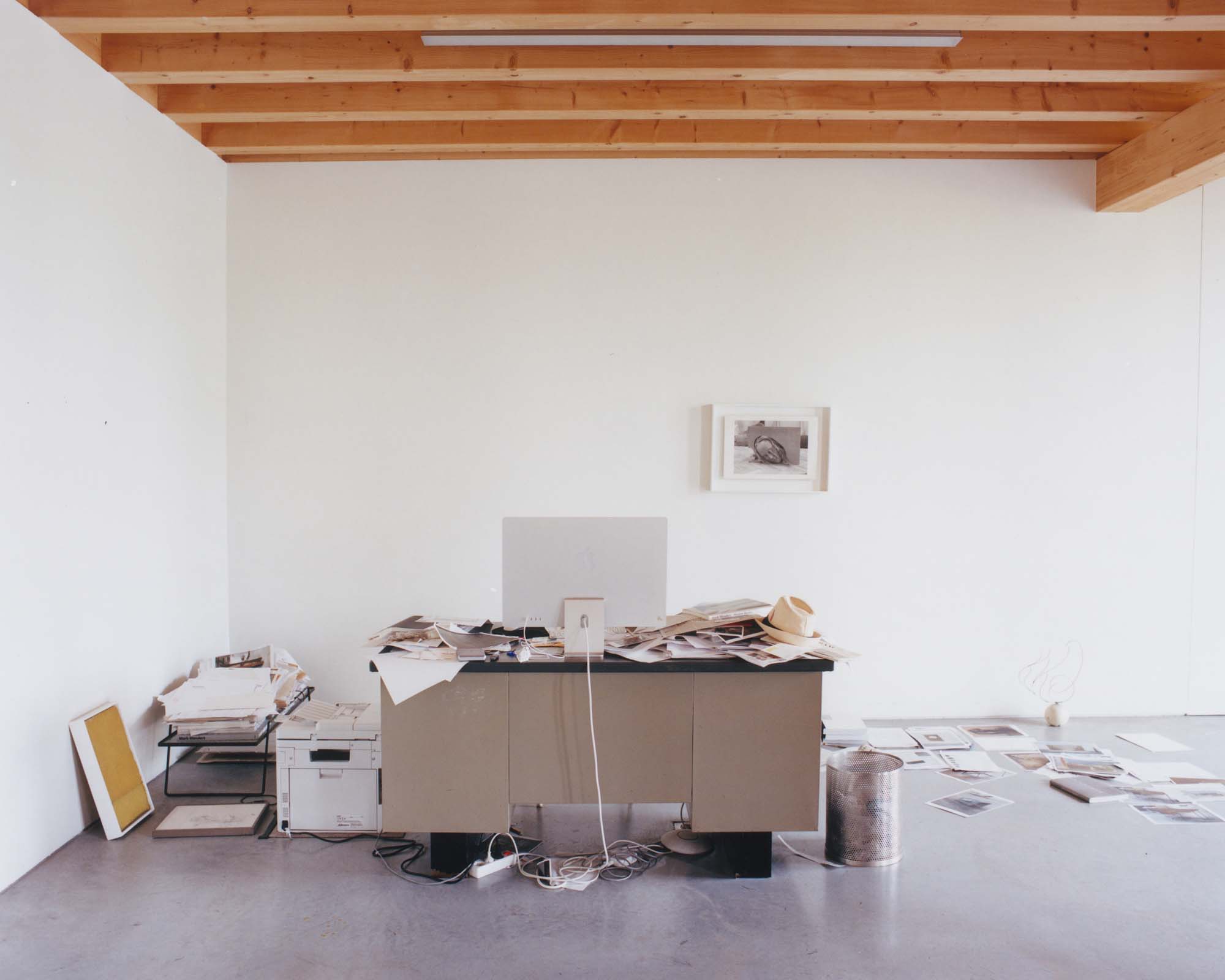
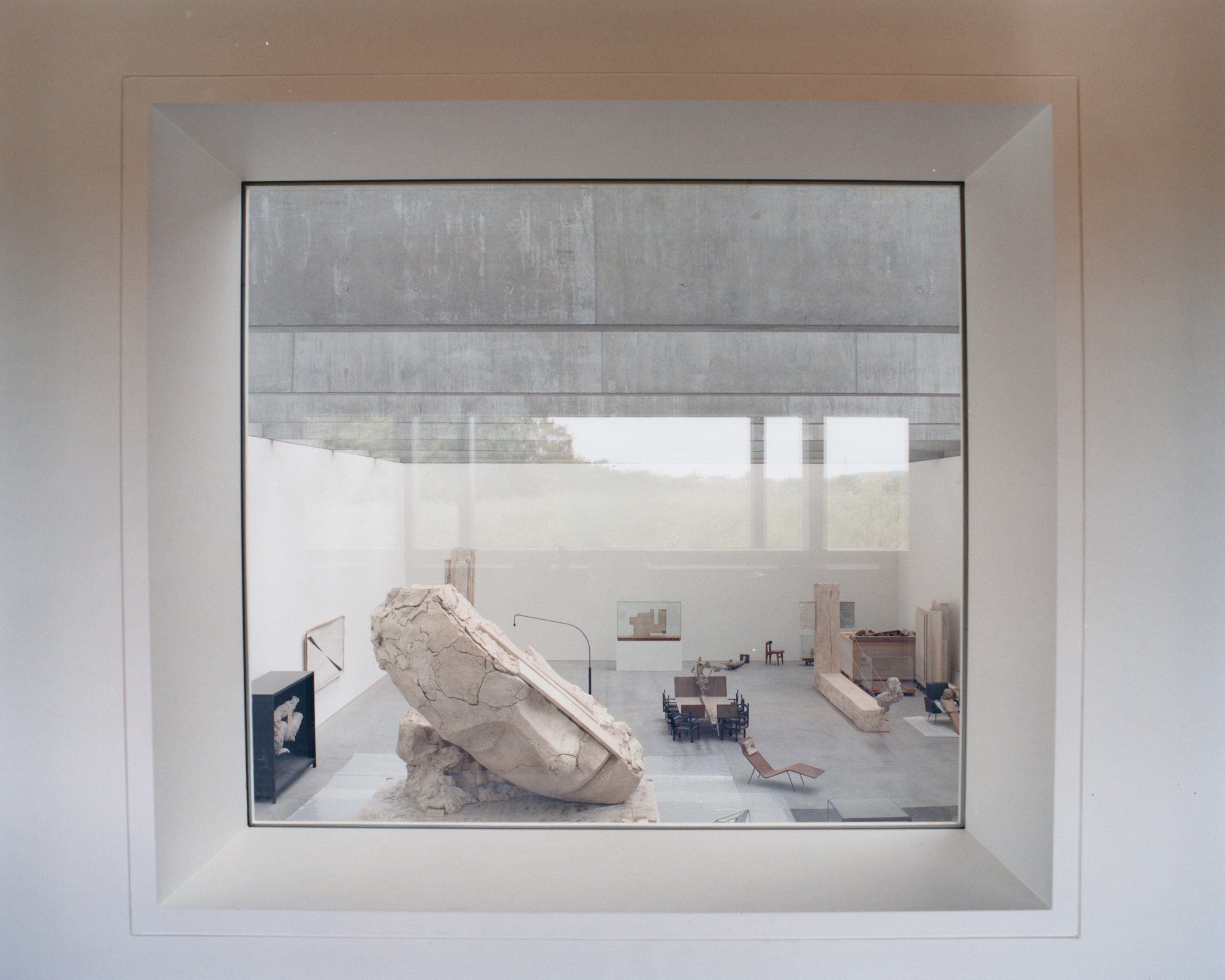
In the last year of art school, I thought, “How can I make one word?” I took one word and I made this dog [out of clay]. And then I made bigger ones, repeating the word but also taking the word “dog” and finding an image for that word in clay, and then by repeating it in different ways, for example, covering it with plastic, it became something much [bigger]. It’s the same idea with making a room with only fives, or a newspaper with fives, or a room with only skiapode images. It’s the same idea, but there’s 30 years in between. I made that dog at art school, but if I show it in an exhibition now, it really feels like I could have made it in this period. There’s no change in language. I can combine works from different periods, and they really feel like they have just been made. Sometimes, I talk about my work as an explosion, a small explosion that grows and grows. And it really feels like that, that everything was already there in the beginning.
It’s a complicated question, because I’m still working on the same work but I also think and learn, and learn and learn. In my case, it’s also complicated because of Self-Portrait as a Building, [through which] I try to freeze as many thoughts as possible. But as a person, I would never do these things in real life, you know? It’s like the main character in a novel goes to a supermarket and cuts the shelf in two—you can write that, but you don’t have to do that. My work is full of things that I would never, never do, but I write it in first person. What I try to do in my real life [is] be a good father; I’m married, I have friends, I look to the people that surround me and I try to learn from how they deal with the toughness of life or the joy of life. I try to translate that into [my work], because my work is really about [what] it is to be a human being. It’s not just a hand in the cave, I want to show more. I don’t want to show a hand, I want to show the hand of a person: [how] a person can think and feel, how [they can] deal with life, and how [they can] deal with the idea that [they’re] going to die. That’s something I want to translate, so it’s a little bit more complex than the hand on wall, but it’s very, very related.