Robert Smithson (1938–1973) was an artist that became closely associated with Land Art, a conceptual movement that emerged in the 1960s, in part as a response to the increasing commercialisation of the art world. Though Land Art emerged as an international movement, it was in North America where artists left a lasting impact—not just in the art world, but on the environment itself. Alongside Smithson, artists including Nancy Holt, Robert Morris, Walter De Maria, and Michael Heizer ventured out across the land, making site-specific interventions in nature. Through landmark exhibitions, such as Earth Works (1968) at the Dwan Gallery in New York, these artists also brought nature into direct contact with the white walls of the gallery setting.
Born in 1938, Smithson grew up in Passaic, New Jersey, and moved to New York in 1957. At this time, his artistic practice consisted of drawing, painting and collaging that had more in common with Pop Art than Land Art. Colourful and often cartoonish, these early works explored themes of religion, science fiction, and pop culture. In 1961, Smithson spent three months in Rome for a solo exhibition of his religious-themed paintings. This trip expanded his worldview and deepened his interest in getting beneath the surface of Western civilisation to its primordial origins.
If Rome is the Eternal City, Smithson saw his native Passaic as “[containing] ruins in reverse, that is—all the new construction that would eventually be built[1]. This is the opposite of the ‘romantic ruin’ because the buildings don’t fall into ruin after they are built but rather rise into ruin before they are built.” It was here, in the post-industrial landscapes of New Jersey, that Smithson developed his understanding of entropy—the gradual decay and disorder of all life and matter—which would soon take root in his work.
Marrying Nancy Holt in 1963, together Smithson and Holt continued to travel regularly, deepening their shared fascination with temporality, geology, and the detritus of human activity. Throughout the mid-1960s, they journeyed between New York and New Jersey—sometimes in the company of other artists and friends, like Donald Judd, Robert Morris, Eva Hesse, and Joan Jonas—where they were drawn to what the architectural historian Sébastien Marot describes as “the most desolate, dull and ‘denatured’ site of these vast ‘spectral suburbs’: empty parking lots, rusting industrial zones, abandoned quarries, halted construction sites.” [2]
By this time, the impact of human activity on the environment was already attracting widespread concern—–as evidenced by the publication of landmark books such as Rachel Carson’s Silent Spring (1962), which pointed to the environmental harm caused by pesticides. In these contaminated, arid landscapes, Smithson saw a means to understand geological time, placing human activity within an expansive temporal framework. This informed his practice across a range of mediums, including major earthworks, drawings, paintings, photography, film and writing.
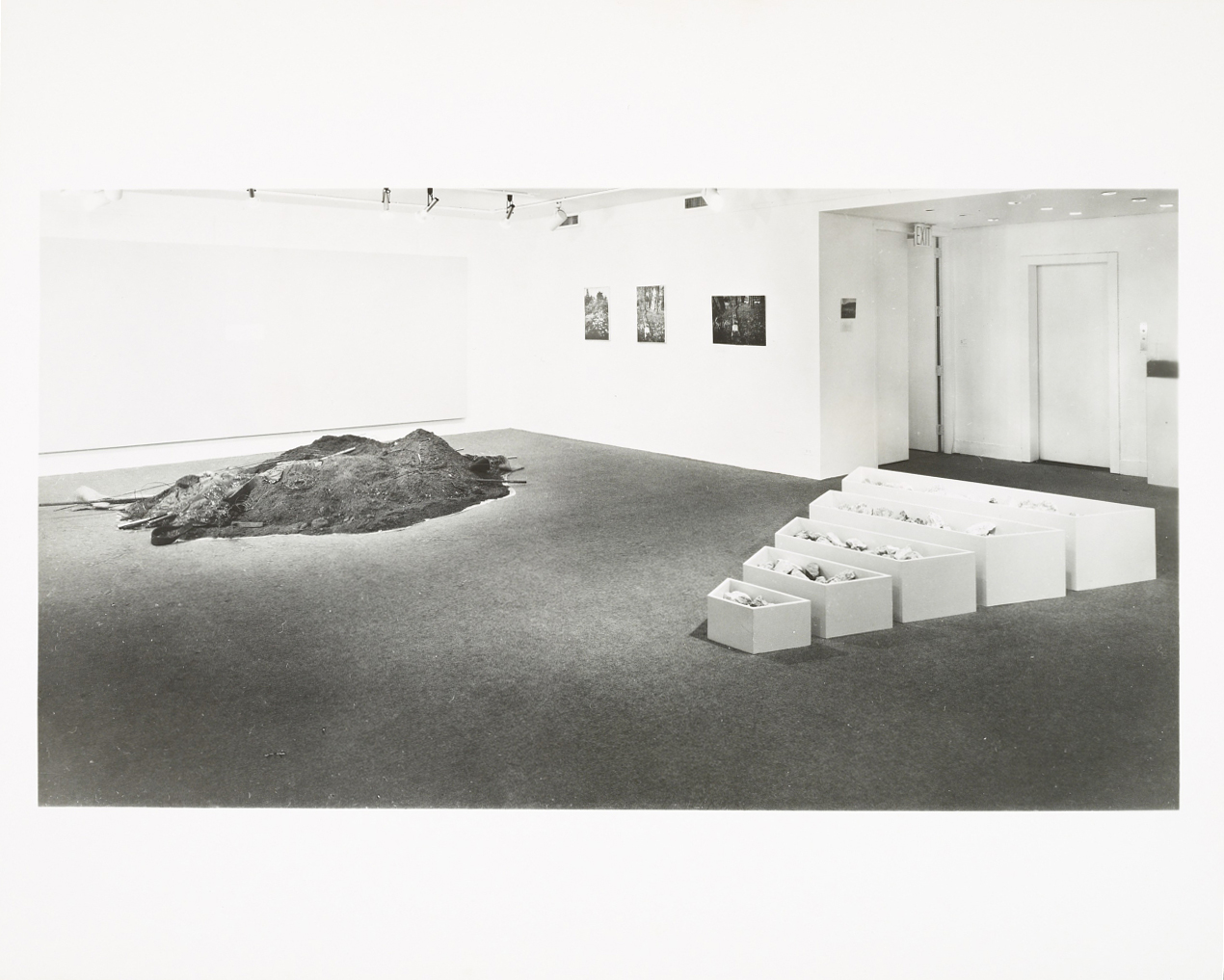
Although he had already started to incorporate sculpture into his practice, in 1968 Smithson began creating what he termed “Nonsites”: sculptures consisting of ephemera—extracted rocks, slate, sand and other geological matter—collected from sites in New Jersey and further afield. He placed these materials into bin-like structures of wood, steel and aluminium, exhibiting them in New York gallery settings alongside photographs and sections of maps that contextualised their sites of origin.
Turning to the site itself, Smithson began searching for an appropriate location on which to construct a site-specific work. While travelling around Utah with Holt, Smithson discovered the Rozel Point peninsula on the northeast shore of the Great Salt Lake. For Smithson, this barren and remote landscape embodied the convergence of his dialectic between site and nonsite. It was the ideal location for what would become Spiral Jetty (1970): a 1500-foot-long coiled formation extending into the lake, consisting of 6640 tonnes of black basalt rock, earth, and salt crystals. Writing about the work’s genesis, Smithson described the immediate vicinity of Spiral Jetty:
“Two dilapidated shacks looked over a tired group of oil rigs. A series of seeps of heavy black oil more like asphalt occur just south of Rozel Point. For 40 or more years people have tried to get oil out of this natural tar pool. Pumps coated with black stickiness rusted in the corrosive salt air… This site gave evidence of a succession of man-made systems mired in abandoned hopes.”[3]
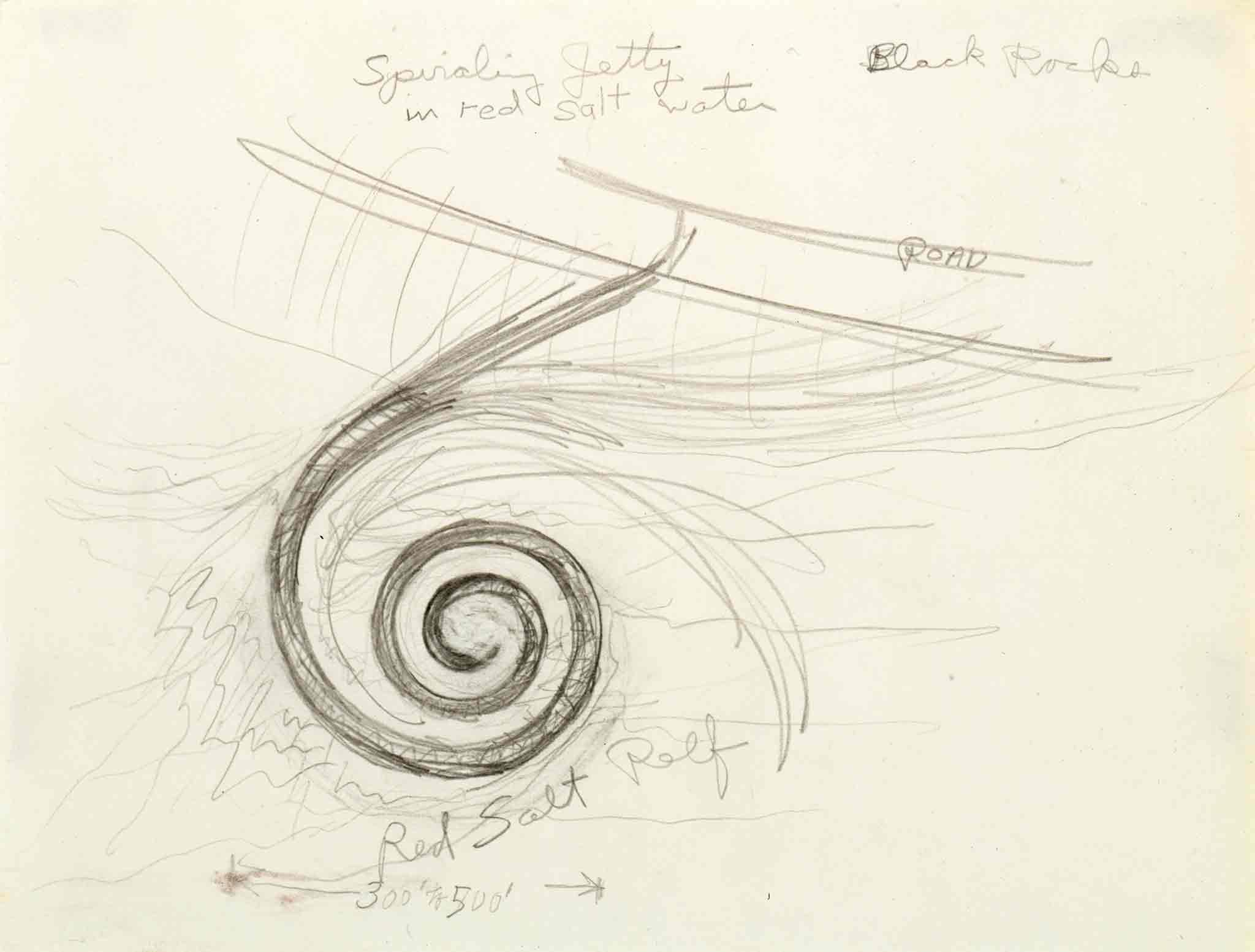
The remoteness of this and other sites chosen by land artists often means that the best, or only, way to experience these site-specific works is through photography, film, maps, diagrams and writing. For Smithson, whose artistic practice had long been rooted in two-dimensional formats, such visual modes of representation were an instrumental part of the earthwork itself. He wasted no time in disseminating aerial photographs and recordings of Spiral Jetty, taken from a helicopter, which vividly captured this vast, glistening earthwork, its colour a murky red from the saline algae in the water.
In the autumn of 1970, some six months after its construction was completed, the Dwan Gallery screened Spiral Jetty, a half-hour film narrated by Smithson, with footage of the jetty’s construction interspersed with other imagery. Photographs by Gianfranco Gorgoni, a prolific documentarian of Land Art, were also widely disseminated in print and exhibited at MoMA in 1971. The following year, Smithson published an essay detailing the work’s development, attesting to the rich multimedia approach that underpinned his artistic practice. So well documented was Spiral Jetty that the earthwork became etched into the collective memory[4]. As the scholar Clark Lunberry writes, reproductions of Gorgoni’s aerial photographs became “an imprint of the real—the Spiral Jetty as it was, as it is, now timelessly there on the lake, in the book.”[5]
Embodying the effects of time on Earth’s geological matter, Spiral Jetty enabled Smithson to dramatically expand his understanding of entropy. As the scholars Philip Hüpkes and Gabriele Dürbeck write, “In the same way in which this prehistoric ocean has disappeared in the course of millions of years of geologic change, the Spiral Jetty will cease to be visible in the future as a result of processes of erosion and sedimentation.”[6] Smithson, too, knew that his rock jetty would inevitably change and disintegrate—albeit gradually, and over time.
And then, in 1972, Spiral Jetty abruptly disappeared. Unbeknownst to Smithson, the earthwork had been constructed during a period of drought when the lake’s waters were below the normal levels. As the water levels rose, the Great Salt Lake swelled to such an extent that, for the next three decades, Spiral Jetty remained submerged beneath its murky red waters. Hidden from view, Gorgoni’s aerial photographs, along with Smithson’s film and essay, became the only way to see this vast earthwork.
Over the years, Spiral Jetty became enshrined in lore. In the 1990s, the jetty started to intermittently reappear. It was upon hearing rumours of its re-emergence that the British artist Tacita Dean embarked on a pilgrimage to the Great Salt Lake, an experience she documented in the sound work Trying to Find the Spiral Jetty (1997), following detailed directions in an ultimately unsuccessful attempt to locate the earthwork. As Dean later recalled, “I only knew what I was looking for from what I could remember of art school lectures: the iconic aerial photograph of the basalt spiral formation unfurling into a lake. In the end, I never found it; it was either submerged at the time, or I wasn’t looking in the right place.”[7]
In the early 2000s, severe drought prompted the most recent re-emergence of Spiral Jetty, which has remained visible ever since. After three decades submerged in the saline waters of the Great Salt Lake, the earthwork has become encrusted with layers of white salt crystals. Where once the black of the basalt rock stood out against the lake’s shimmering waters, the jetty has become harder to distinguish against the cracked earth of the lake’s sunbaked basin.
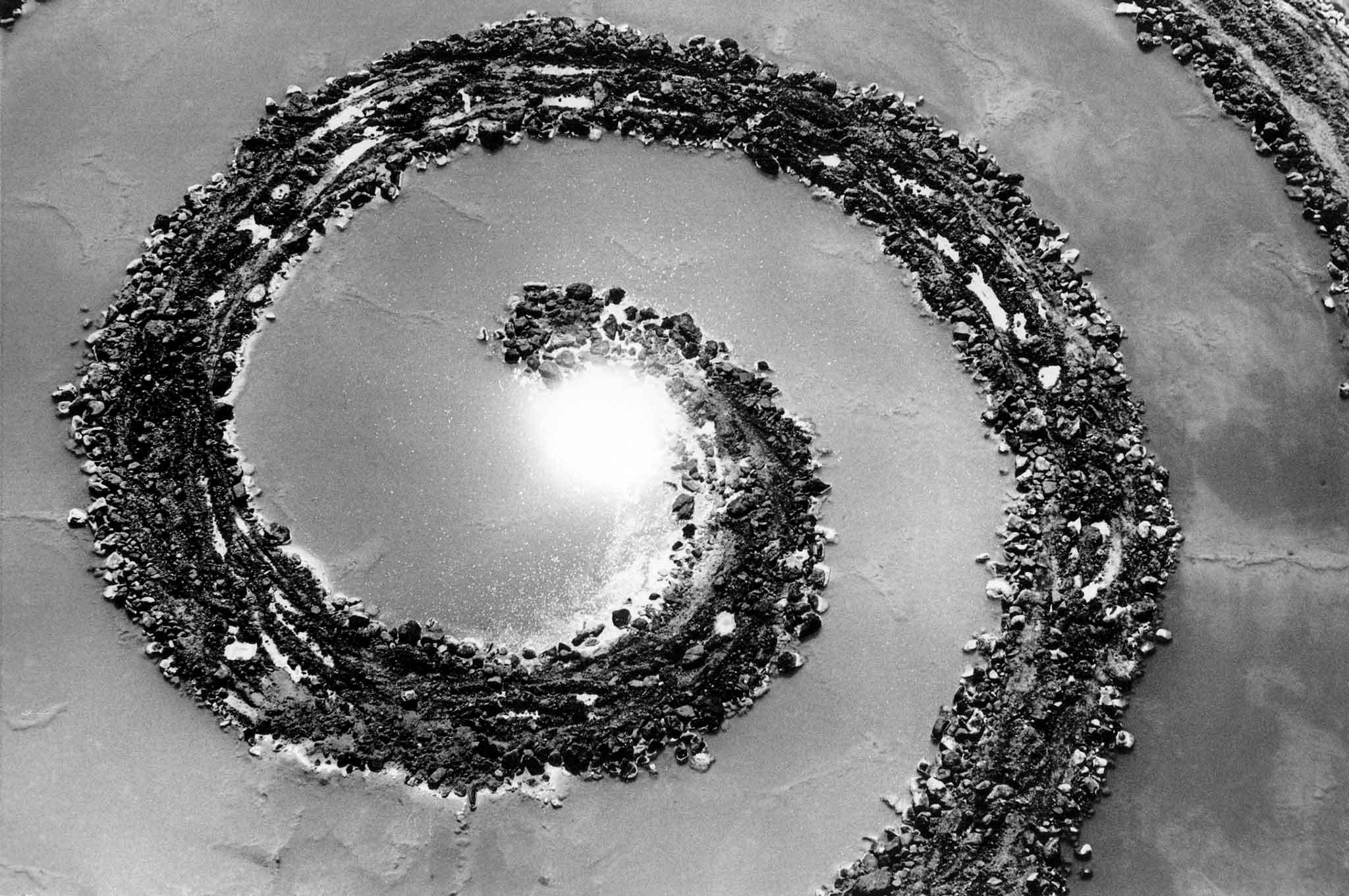
Since its re-emergence, scientists have warned that sustained droughts could see the Great Salt Lake dry up entirely within the next few years[8]. Though it was always the intention that Spiral Jetty would eventually disappear, the speed at which this process is likely to occur is far greater than Smithson could have imagined, laying bare the impact of the climate crisis and human activity on the environment.
In recent years, Smithson’s work and writing have been discussed within the context of the Anthropocene debate, a term used to refer to the geological epoch shaped by human activity. Hüpkes and Dürbeck, for example, describe Spiral Jetty as “an anthropocenic imprint on the earth.”[9] While Smithson would not have encountered the Anthropocene debate in his lifetime, his attention to post-industrial landscapes attests to a clear understanding of the human impression on the Earth’s geology.
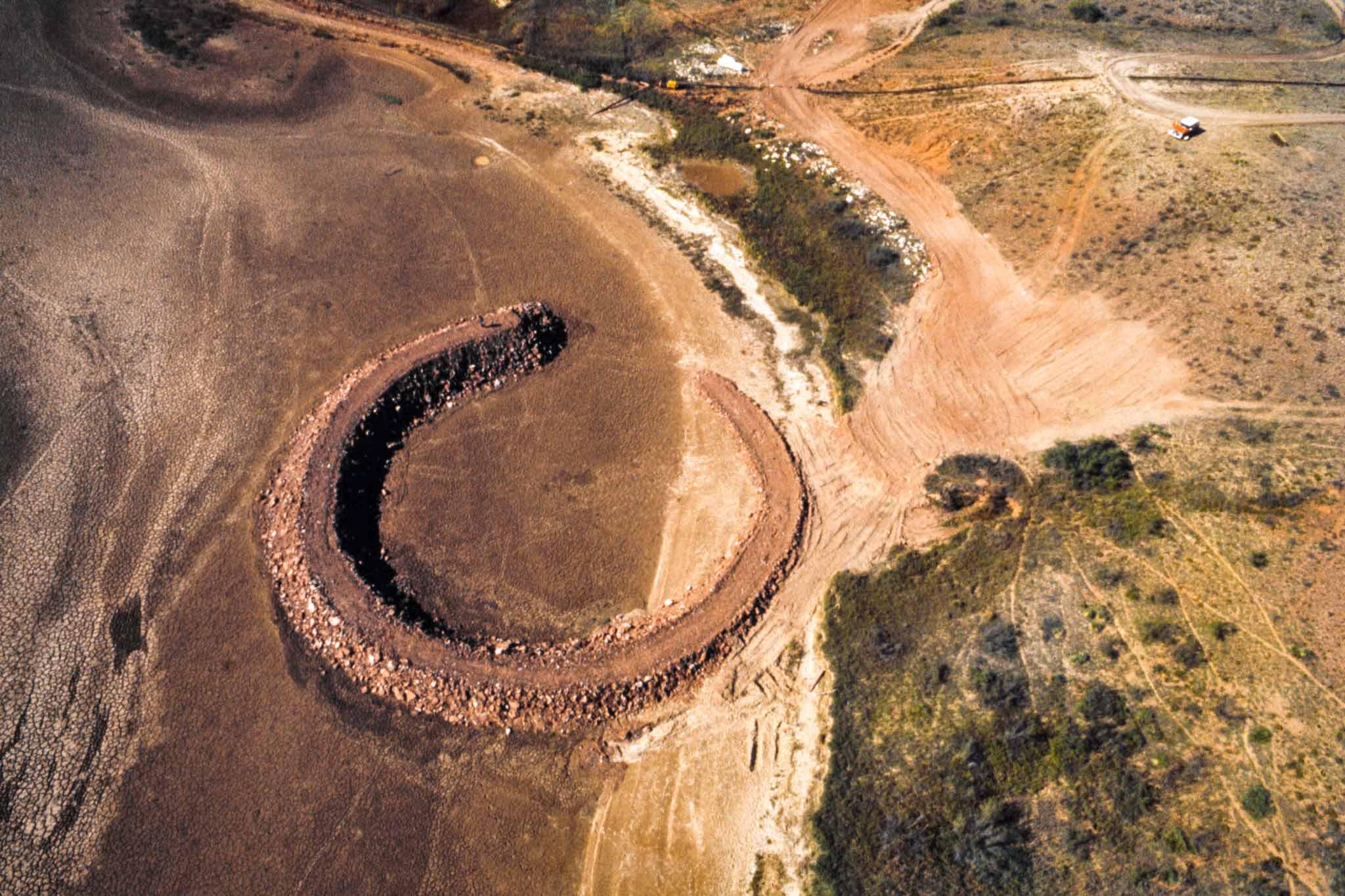
A product of the postwar world, Smithson witnessed profound transformations as the West shifted from the heavy, fuel-intensive manufacture of the industrial age to a service economy driven by mass consumerism—both of which contributed to a degradation of the natural environment: mining churned through the earth to extract raw materials, just as human-made materials constitute a significant proportion of sediment. However, he did not live long enough to witness the implications of the changing environment on his extant earthworks. In 1973, Smithson was preparing for the construction of Amarillo Ramp (1973) at the edge of Lake Tecovas in Texas, a man-made dam built in the early 1960s and later drained. During a reconnaissance flight over the site, the plane carrying Smithson, pilot Gale Ray Rogers, and photographer Richard I. Curtin crashed, killing all on board. After his death, Holt—with the assistance of artist Richard Serra and art dealer Tony Shafrazi—oversaw the construction of the ramp according to Smithson’s specifications, which involved draining part of the lake and using rock from a nearby quarry.
Completed that same year, photographs of Amarillo Ramp show a 150-foot-long ramp curving dramatically in the dried basin of the dam and emerging out of the earth with fervour, creating the impression of earthen skid marks left by a gigantic tyre. Like Spiral Jetty, however, Amarillo Ramp is difficult to see in person. For one, the earthwork is located on private property—it had been commissioned by a local ranch owner—meaning visitors cannot stumble upon it by chance. At the same time, shrubbery has begun to reclaim the site of the artificial lake, and the ramp has gradually eroded, crumbling back into the earth from whence it came.
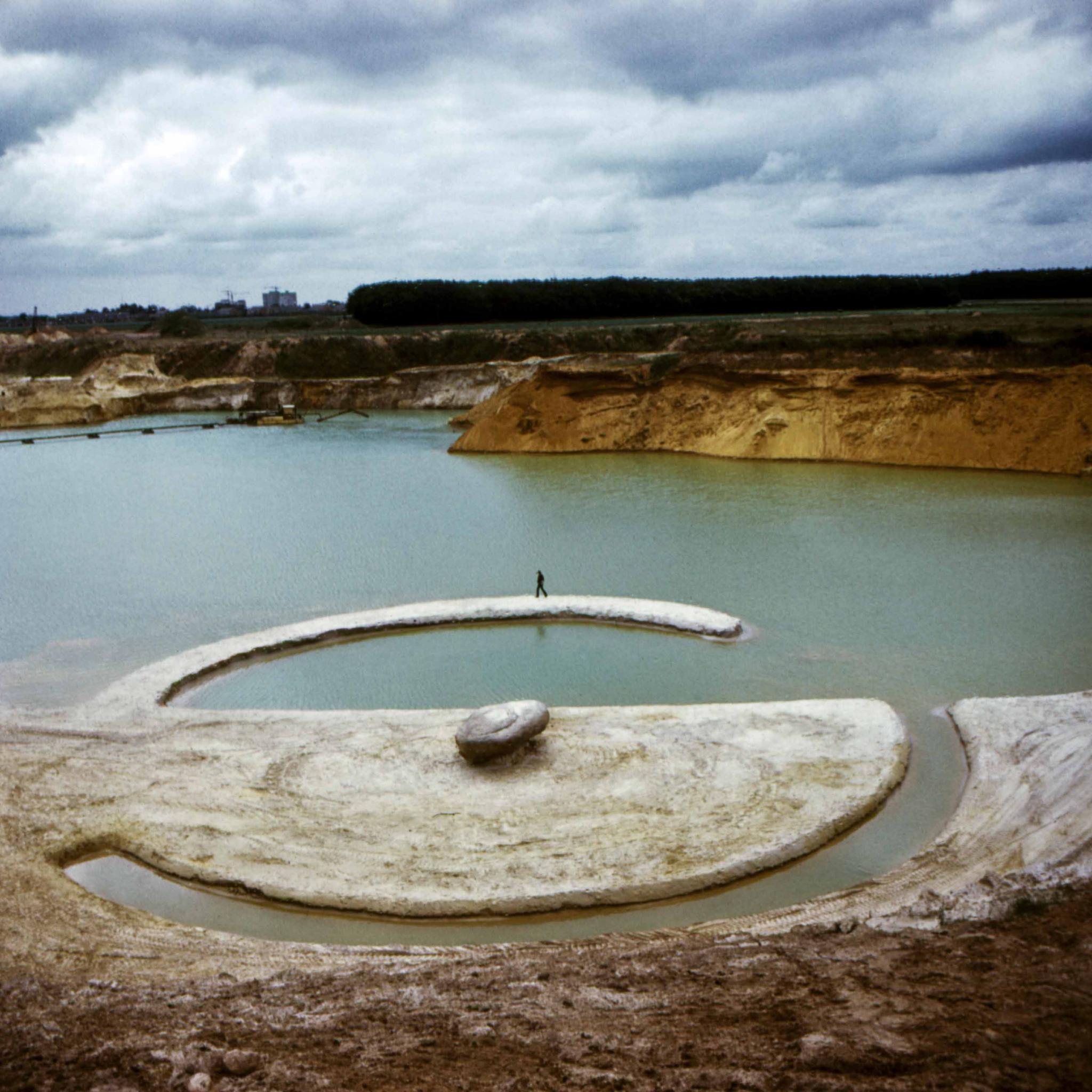
As Spiral Jetty and Amarillo Ramp deteriorate over time, another of Smithson’s extant earthworks, Broken Circle/Spiral Hill (1971), points to a different notion of temporality. Invited by the curator Wim Bereen to participate in an open-air sculpture exhibition commissioning site-specific works located beyond the confines of the Sonsbeek Park in Arnhem, Holland, in 1971, Smithson’s chosen site—a sand quarry in Emmen in the northeastern province of Drenthe—was decidedly unconventional. Though only ever intended as a temporary installation, Smithson was keen that Broken Circle/Spiral Hill be seen as a “gift” to the people of the Netherlands, remaining in-situ, even as the site continued to function as an active quarry.
Broken Circle/Spiral Hill consists of two components: Broken Circle, a semicircular jetty made from sand and water that sits at the edge of a quarry lake with a glacial boulder at its centre; and Spiral Hill, an earth mound with a sand footpath winding uphill counter-clockwise. From the top of Spiral Hill, viewers can look out across the quarry and down onto Broken Circle, adopting the aerial perspective through which Smithson’s earthworks have become best known. Seen from above, viewers can also look out across the quarry site’s irreparably altered industrial landscape, offering a view into the entropic realm that informed much of Smithson’s work. [11]
Though Smithson wrote of “ideas [decomposing] into stones of unknowing,” the impression he left on how we visualise entropic landscapes has not faded from view, even as his vast earthworks slowly decay. Like Spiral Jetty and Amarillo Ramp, Broken Circle/Spiral Hill no longer resembles its original form: vegetation was added to Spiral Hill after the earth mound began to deteriorate, and the sand jetty is now partially submerged by the quarry lake, visible only from above. In 2025, it was granted status as a provincial monument in the rural province of Drenthe. Though access remains limited to official bus excursions—with several trips organised in collaboration between the current mine owners and the Holt/Smithson Foundation in 2025 and 2026—Broken Circle/Spiral Hill and other of Smithson’s earthworks have collectively transformed post-industrial landscapes into unlikely sites of pilgrimage, not unlike Smithson’s own visits to the ruins of Rome.