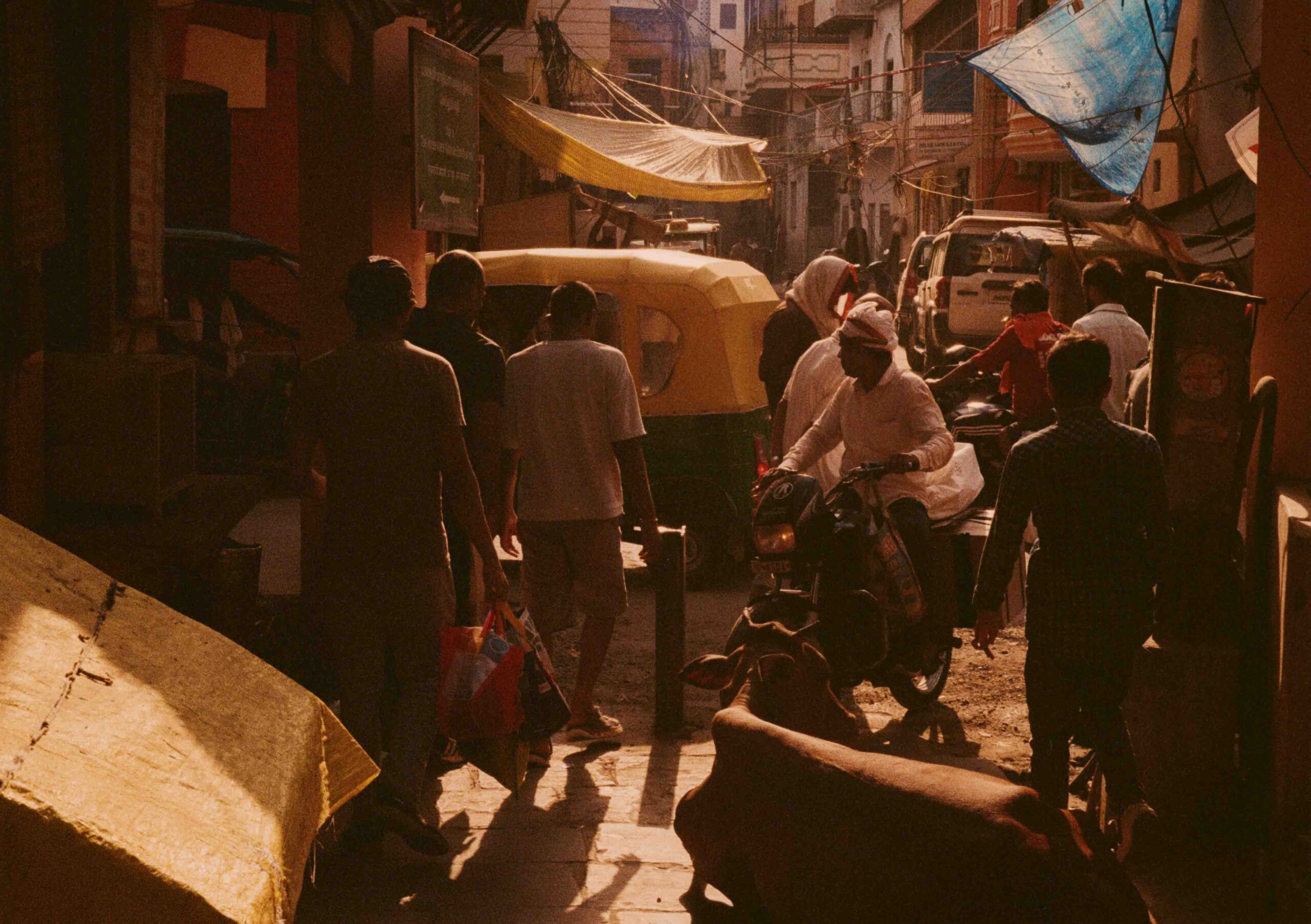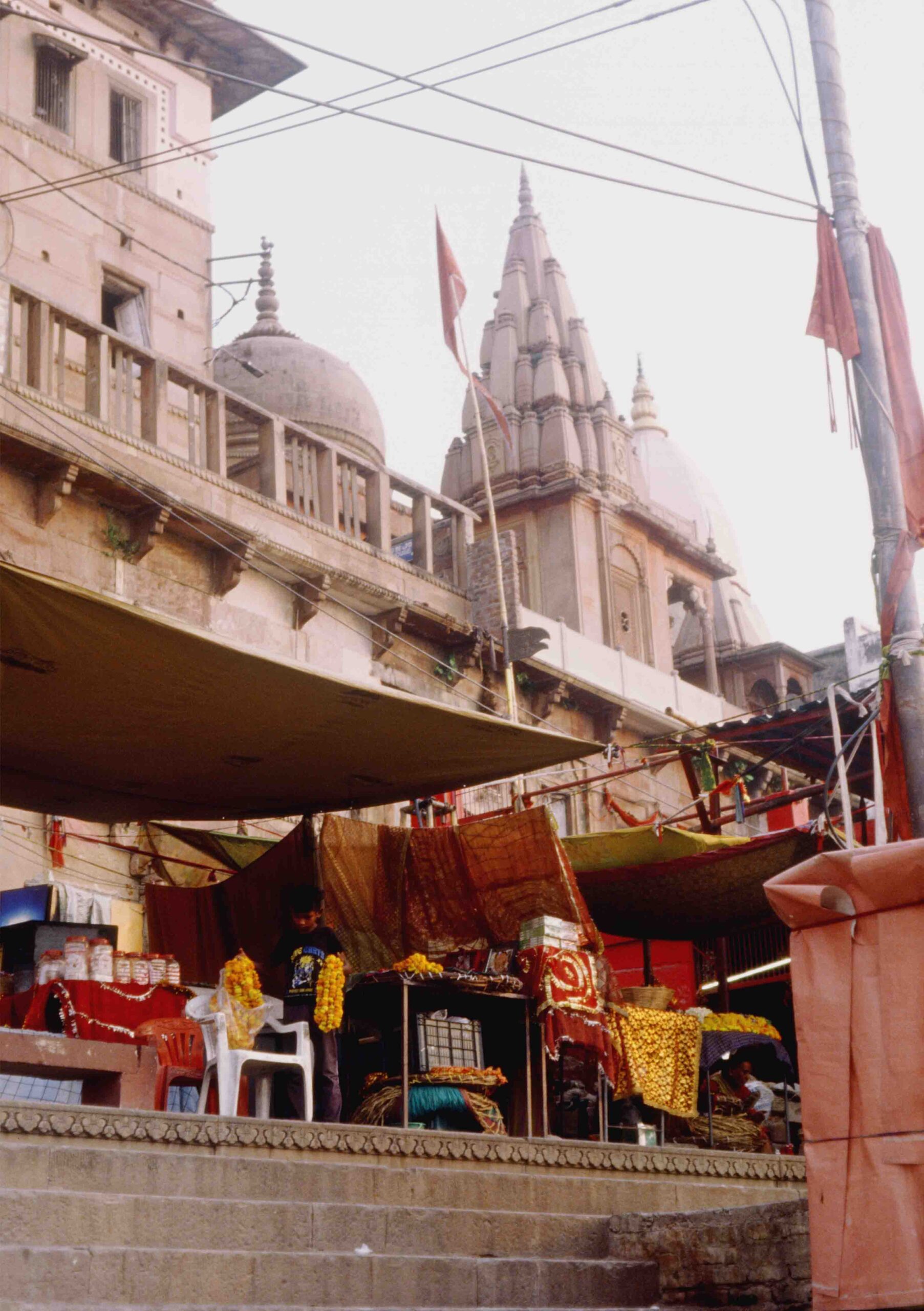
There is an odd stench to a burning body. Those who have smelled it—especially in times of violence—say it never leaves you. In Banaras, this smell is not hard to come by. It is a city that bustles with life: the cry of roadside vendors, the call of boatmen, the incessant honking of cars driving millimetres away from each other, as cows hold up traffic. Yet it is also a city where people come to die.
Mukti Bhavan, a modest guesthouse along a narrow lane, has mint-green exterior walls. Inside, the paint is peeling off, its 10 rooms bare, aside from a wooden cot. A single window—an illuminated rectangle—lets the sunlight in. It is here that the elderly or ailing arrive to spend their final days, usually accompanied by family. The charity-run establishment provides rooms at minimal cost: 20 rupees a day to cover basic electricity usage, waived for those who cannot afford it. There’s just one rule: guests are allowed to stay for a maximum of 15 days. If someone doesn’t pass away within this window, they are asked to vacate the premises in order to make space for others. [1]
There are more such salvation homes. Mumukshu Bhavan receives countless applications year-round and has an extensive screening process for potential residents, who must pay a donation of around 100,000 rupees. Preference is given to those over 60 years old, who have life-threatening illnesses, are financially capable of handling their daily expenses, and have relatives to arrange final cremation rituals. The set-up, here, is slightly different: out of 116 rooms—some bigger than others and equipped with air conditioners—only 40 are reserved for Kashivasis, spiritual pilgrims from Kashi who spend years chanting prayers together in anticipation of death.[2]
In 1896, American author Mark Twain visited Banaras during a tour of India, writing: “[It] is older than history, older than tradition, older even than legend, and looks twice as old as all of them put together.”[3] This ancient region has various names: the original, Kashi, translates in Sanskrit to “city of light.” Varanasi is the official name, derived from the confluence of the Varuna and Assi rivers, and Banaras is a phonetic variation, used extensively since the Mughal and British ages to describe the region’s cultural heritage—from the Banarasi tabla gharana of Hindustani classical music to the opulent sari weaves and melt-in-the-mouth paan.
Like Twain, many believe Kashi to be the oldest city in India, even the world. But this claim rests on the legend that it was established by the Hindu God Shiva in 3000 BCE—while all evidence suggests it was actually founded on the banks of the Ganga some 2000 years later. [4] Considered by Hindus to be the most sacred river, the Ganga has shaped the history, culture and lifestyle of Banaras. As it passes through the city, it takes a peculiar turn northward, creating a natural crescent-moon shape. By its banks, Kashi transformed into a prosperous trading hub; the river serving not only as a vital conduit for handcrafts and cultural exchange, but also the centre of faith. [5] Ancient Hindu scriptures, like the Matsya and Skanda Puranas, claim that dying in this city and having your ashes scattered in the holy Ganga allows one to attain moksha: freedom from the cycle of death and rebirth. Shiva, the destroyer of the universe, personally whispers a mantra into the ear of the departing soul, releasing them from all earthly ties.
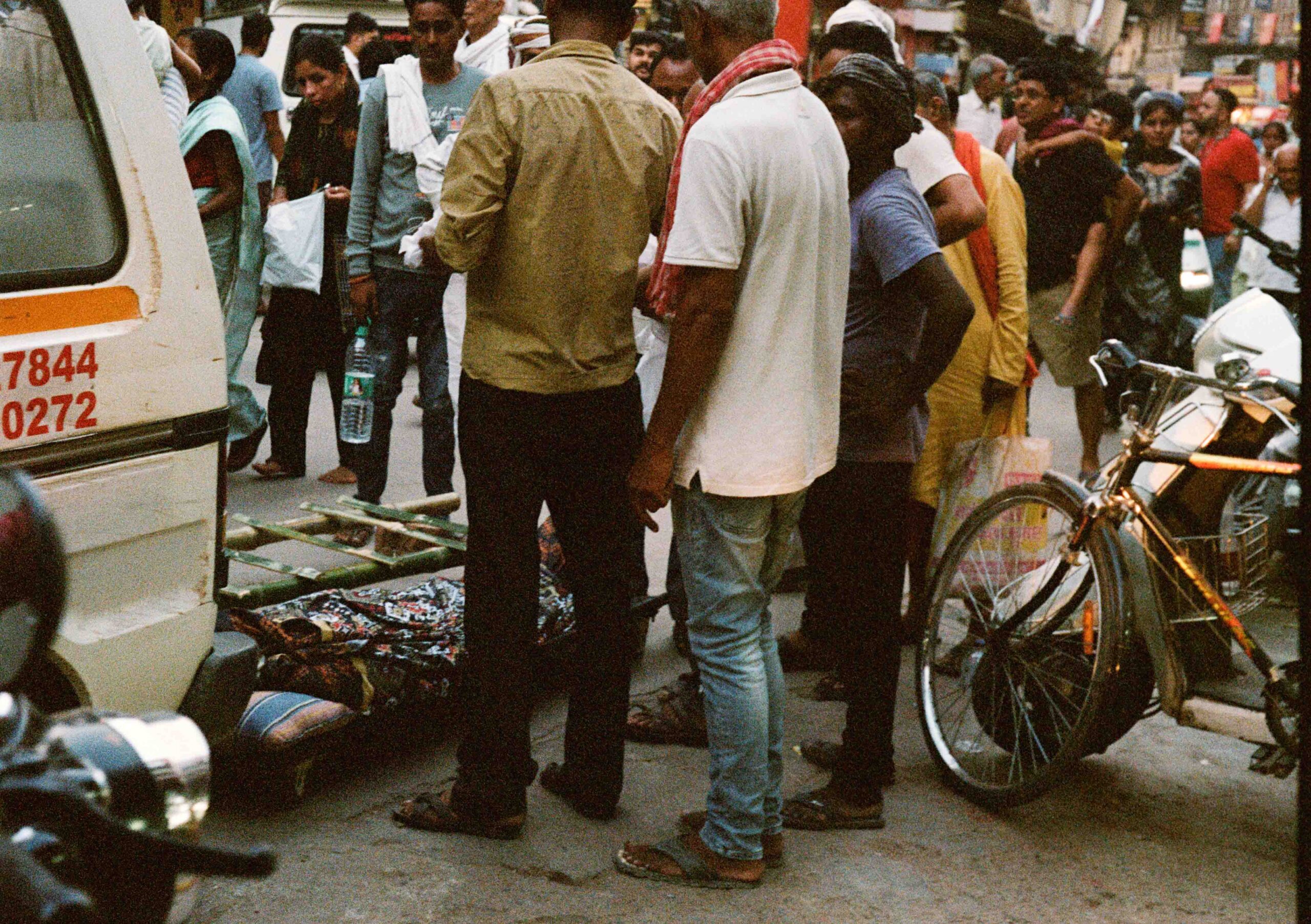
And so, the funeral pyres burn without ceasing at the Manikarna and Harishchandra ghats, their orange flames creating a watery film behind which everything trembles before transforming into thick, grey smoke. The sight inspires a mix of reverence and morbid curiosity amongst outsiders. Every few minutes, small processions of men carry in a corpse on a bamboo bier, solemnly chanting: Ram naam satya hai [God’s name is the truth] [6]. This sacred fire, looked after by the Dom community, is believed to have been lit centuries ago, its flame never once going out since. Nearby, steps lead down to the murky Ganga—now black from industrial and human waste—in which small boats seating tourists and pilgrims row past, witness to this public spectacle of grief.
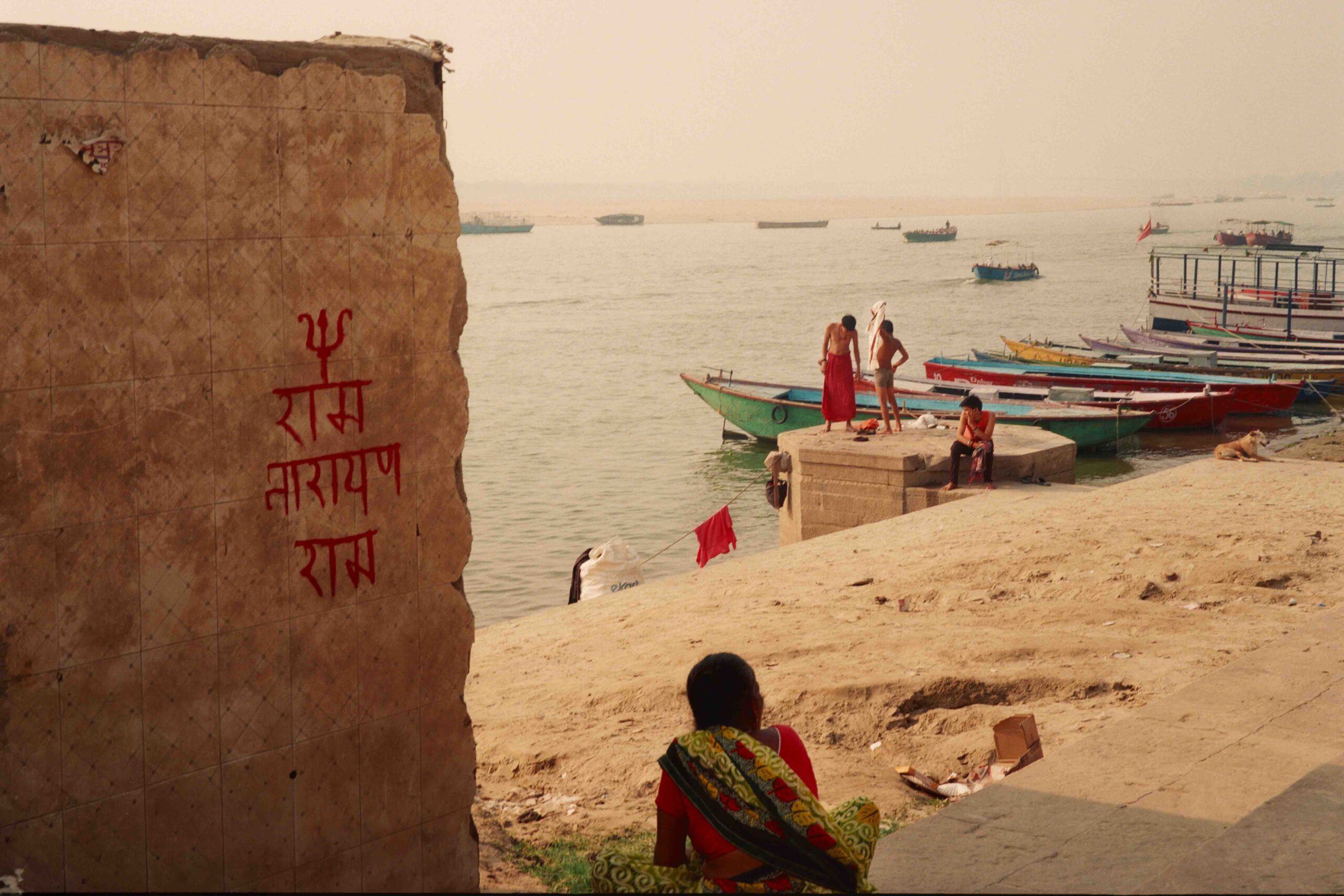
There’s something pacifying, almost harmonious, about watching a loved one’s corpse being set alight. It feels definitive; a pause, a moment hanging between life and death. Before it is set on fire, the body is lathered in ghee, clarified butter, so it ignites easily. There is a method to everything, a ritual for every moment. In the final minutes of life, drops of packaged holy water from the Ganga are touched to the lips of the ailing to cleanse them of all sins. A day or two after the funeral, the family selects unburnt bone fragments from amongst the ashes at the shamshaan. These are immersed in a nearby holy river full of coarse, sand-like human remains floating on the surface—too filthy to step into. A grey bone aimlessly drifts past, completely disconnected from the human it once belonged to.
It is comforting to think there is a process to death, that this has happened before and there are people who remain unphased, knowing exactly what to do when it inevitably comes. In her book From Here to Eternity (2017), mortician Caitlin Doughty writes about the solace that rituals can bring to the bereaved, imposing structure upon chaos. The Toraja people of Indonesia, for instance, keep the embalmed bodies of deceased relatives at home for months or years, treating them as if they are sick or asleep. In Japan, kotsuage ceremonies involve using large chopsticks to pick a loved one’s remaining bones out of the cremation ashes and place them into an urn. “Holding space doesn’t mean swaddling the family immobile in their grief,” Doughty elaborates. “It also means giving them meaningful tasks. Using chopsticks to methodically clutch bone after bone and place them in an urn, building an altar to invite a spirit to visit once a year, even taking a body from the grave to clean and redress it: these activities give the mourner a sense of purpose.”[7]
And yet, no loved one can bear to stand by the pyre for the entire three to four hours it takes for a corpse to disintegrate. Waves of heat radiate outwards; the skin glistens with sweat. In Benaras, the Dom community—at the bottom of the caste hierarchy—pays the price for these customary rituals. Their occupation is inherited, work intensive: it involves standing beside the pyre’s extreme heat, without any protective gear, and turning the body with a stick to ensure it is reduced to ash. Injuries and blisters are common, and the constant exposure to thick smoke severely damages their eyes and lungs. Despite spending as many as 18 to 20 hours tending to fires daily, most workers only make about 600 rupees or $6 a day: 200 rupees or $2 per cremated corpse. [8]
What happens to the lives lived in such close contact with death? To the men from this community deprived of other jobs and forced to work in gruelling conditions, lacking the means or funds to process their experiences? Even children do not escape unscathed: boys as young as five or six search through cremation grounds for the used shrouds cast aside before a body is burnt—which they then sell at a meagre price to shop owners, who repackage and sell them at marked-up prices to mourners. These children also carry home remaining charred timber from pyres to use as cooking fuel. Sometimes remnants of flesh are still stuck to the wood. When they turn 11 or 12, the boys, too, start burning bodies. [9]
“Some of these men described the grotesque sights they witnessed while engaging in cremation work,” researcher Radhika Iyenger writes in Fire on the Ganges (2023). “One worker, for instance, told me that he had cremated ‘corpses with smashed skulls, severed limbs, gunshot wounds, knife-torn torsos… [and people] who had died by suicide.’ What he found most repugnant was the sight of bones crackling in the fire, and flesh sliding off as it was subjected to intense heat. Another cremator confessed: ‘If you see death over and over again, you will end up doing nasha [substance abuse]. Otherwise, you’re not human…’ Dehydration, prolonged exposure to heat and smoke, alcohol and drug addiction lead to myriad ailments and even premature death—many men who work at the cremation grounds do not live beyond their late 60s.” [10]
So much is invested in sustaining the myth of Banaras as a city older than time that it feels impossible to imagine it any other way. What was this place like centuries ago when it was truly old, still untouched by religion? When the Ganga flowed cleaner and the ghats were not steps constructed from limestone bedrock, but natural features shaped by the force of water? The Jataka Tales, an ancient collection of Buddhist fables, uncover a period when Kashi was not as strongly associated with Hinduism. [11] The climate was gentle, breezy: dense woodlands covered the swampy region and trees flourished over thick undergrowth. In around 800 BCE, settlers cleared this swampland to start farming. [12]
Kashi today would seem unrecognisable to those that once inhabited it. While moksha packages are sold to spiritual tourists, the Ganga has become one of the most polluted waterways in the world. Industrial waste and sewage inflow from 450 million people is dumped in the same holy river that thousands bathe in to cleanse their sins. Animal carcasses float in the water. An estimated 32,000 corpses are cremated in Varanasi each year, their ashes ending up in the Ganga. The bodies of the poor, who cannot afford a proper cremation, are also thrown in, sometimes half-burnt. [13]
In the early 1990s, the Indian government devised a unique solution to this problem: flesh-eating turtles. The soft-shelled Trionyx Gangeticus, found in and around the Ganga, had already demonstrated a taste for deceased flesh by raiding extinguished funeral pyres. Some $32 million was spent on the programme, which released around 25,000 turtles into the river over the span of a decade. Bred on a government farm in Banaras, this species was raised on a diet of exclusively dead fish so they wouldn’t develop a taste for the living. In addition to being plagued by corruption and mismanagement, the plan failed because no attention was paid to making sure these turtles could survive in the wild. Instead, they were poached and killed in the thousands. [14]


Other species in the Gangetic region are also on the brink of extinction. The Ganges river dolphin is functionally blind and has evolved to use a system of echolocation to navigate its murky river waters, often swimming sideways. Considered one of the rarest dolphin species, there are estimated to be only around 6000 surviving today. [15] Various species of otter living by this river are also classified as vulnerable. The Gharial, a long, crocodile-like reptile with a slender snout, known for its shy, non-aggressive nature, is also critically-endangered, with a little over 3000 remaining across the globe. It is a miracle, sacred in itself, that these animals still endure in the Ganga, despite human interference.
On land, the situation is equally dire: a single cremation can require up to 1000 pounds of wood, often harvested illegally from nearby forests. [16] Banaras, the ancient city, stands in a continuous grey haze, consistently ranking amongst the most polluted cities in the world. The Air Quality Index (AQI) frequently crosses an alarming 400, an emergency state that affects both the sick and healthy. [17]
But still the funeral pyres remain ablaze, paying little heed to the hefty cost of these rituals. The business of death continues as usual, taking many more with it: unnamed, unacknowledged. Orange flames—and that odd stench of burning flesh—swallow the sky. Banaras continues to burn.